Will 1793 Take Place? :
Destituent Remarks on the Chilean Uprising and the Yellow Vests
Groupe Révolutionnaire Charlatan
First published in French in August 2026, the present article argues that the 2018-19 Yellow Vests movement in France and the 2019 Chilean uprising form two instances of a single pattern. In each case, an insurrection begins with modest demands, such as a metro fare or a fuel tax only to then explode outward, outstripping its own stated goals, before ultimately being contained by constituent processes, referendums, and left-wing electoral projects. The authors treat the Constitution of 1793, with its famous article on the “duty of insurrection,” as the archetypal "act of capture" for such sequences: on the one hand, it was an attempt by ruling powers to absorb revolutionary energy into itself; at the same time, it served to embed a permanent insurrectionary principle into the political-legal system, one which the state has never been able to fully extirpate. Against the left's push for new constitutional initiatives, the authors argue for a "revolution without power" grounded in the refusal of institutions and representation, crediting the Yellow Vests with developing new forms of assembly and fleeting affiliation in the absence of a distinct language or subject of its own. The key question, they suggest, is ultimately not whether 1793 will take place, but who will finish the job.
Then annihilate forever what may one day destroy your work. Consider that the fruit of your labors being reserved for your grandchildren only, duty and probity command that you bequeath them none of those seeds of disaster which could mean for your descendants a renewal of the chaos whence we have with so much trouble just emerged. At the present moment our prejudices are weakening; the people have already abjured the Catholic absurdities; they have already suppressed the temples, sent the relics flying, and agreed that marriage is a mere civil undertaking; the smashed confessionals serve as public meeting places; the former faithful, deserting the apostolic banquet, leave the gods of flour dough to the mice. […] One more effort; since you labor to destroy all the old foundations, do not permit one of them to survive, for let but one endure, 'tis enough, the rest will be restored. And how much more certain of their revival must we not be if the one you tolerate is positively the source and cradle of all the others! —Marquis de Sade, Philosophy in the Bedroom, 1795
In Santiago as in Paris
Chile, October 25th, 2020.1 After months of insurrectionary demonstrations, the government agrees to hold a referendum to elect a constituent assembly. The vote takes place on the 15th and 16th of May, 2021, and on July 4th the assembly begins its work, which is to last for a period of one year. With the initiation of the constituent process, another quite distinct process draws to a close: the revolutionary process. The latter began on October 7, 2019 when groups of young people, dissatisfied with the rise in metro fares, decided to refuse to pay and to jump the ticket barriers en masse. Collective ingenuity, the joy of rebellion, the determination of the primera línea (frontline), the feeling of being on the verge of storming heaven, all gradually give way to self-serious protocols and democratic formalism. On two separate occasions, the newly drafted constitution is rejected in referendums and abandoned. The rest is history: the left wins the elections of November–December 2021 with an abstention rate of roughly 50 percent, taking power in March 2022. Yet the aftermath proves disappointing and, in December 2025, a far-right candidate, the son of a Nazi, is elected as the country’s leader against a backdrop of a spectacular rise in voter turnout (up thirty-eight percent in the first round, and twenty-nine in the second). Once again, hopes for a Chilean path towards a freer and more egalitarian society are dashed. Once again, counterrevolution succeeds in stifling the revolutionary process, by imposing upon it the timeframe and institutional forms of democratic power: the mirage of a referendum, a moment of national electoral unity, a left-wing government, and a breakthrough by the far right.
In France, the Chilean uprising enjoyed a certain resonance with the Yellow Vests movement. It was not the price of the metro ticket but rather the cost of fuel that sparked the unrest, dragging out into the open the aspirations and courage of hundreds of thousands of people confronting the rising cost of living, the unwavering contempt of those in power, constant disparagement in the media, and the extreme brutalization of law enforcement. The grievances of the Yellow Vests included the resignation of Macron, a reshuffling of government, and still more importantly, increased active participation among citizens in political life through the Citizens’ Initiative Referendum (RIC). In the absence of anything else to articulate, uprisings always begin with such demands. But the specific demands of the movement should not obscure the fact that, rather than simply opposing a particular tax or government, this was a struggle for the dignity of life. To put it another way, what the movement said did not fully reflect what it wanted. In the absence of a common language, its actions went further than its words, without ever truly finding a way to express its aims. This distinguishes it from the so-called Marxist revolutions, which inherited the language of their century, even though their substance may have differed from what their ideology implied (representative democracy, a mixed economy, parliamentarism, tax justice, agrarian reform, etc.). There is always a disconnect between the desires expressed and experienced during an uprising and what subsequently materializes: this “cunning of reason” is the crucible of the insurgents and their failed emancipation.
The disruptive force of the Yellow Vests movement took everyone by surprise, plunging the status quo into crisis. This enabled it to test and transcend certain institutional forms without becoming entrenched within them: a categorical rejection of representation and leaders, a rejection of the separation between periods of deliberation and decision-making, the abolition of Saturday as a day like any other, the suppression of the typically alienated usage of roads and roundabouts, a rejection of right-wing and left-wing allegiances, the blurring of identity-based labels, and a general rupture with the default social fragmentation through the sharing of thoughts, words and meals. Given all of this, there is little basis for asserting that the movement would necessarily have taken on a constituent dimension had it been victorious — if the word “victory” still has any meaning. This is true, even in spite of its heavy-handed and obligatory references to the French Revolution — those found in school textbooks — which constituted the only shared imagery immediately accessible to the fluorescent crowds. Amidst the whole arsenal of symbols and emotions deployed, from the Phrygian cap and the Marseillaise (which, in some places, ended up being reduced to the cry, “To arms!”) to the sense of belonging to a transhistorical party of “the little people,” one also found this notable phrase: “When the government violates the rights of the people, insurrection is the most sacred of rights and the most indispensable of duties for the people and for each portion of the people.” It originates in Article 35 of the never-implemented Constitution of Year I, promulgated on the 4th of August, 1793, four years to the day after the abolition of privileges.
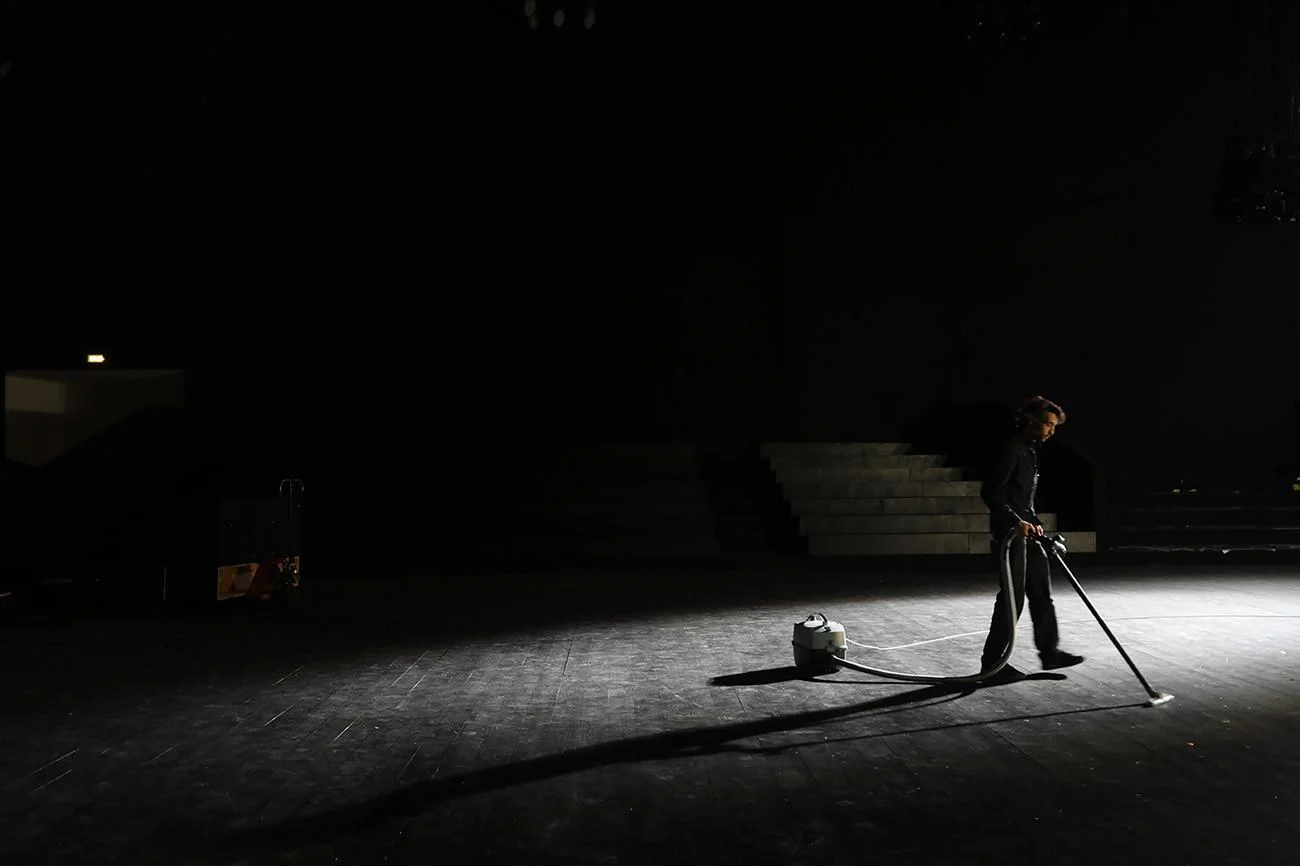
Everything worth saying about the Chilean constitutional process has already been said. As for the uses and abuses of “our” French constitution, these are widely discussed in the press and the media. All that remains is to offer, with all due modesty, a few comments on this famous Constitution of 1793, which resonated so deeply with the Yellow Vests that it even reawakened something akin to the sentiment of the sans-culottes, torn between becoming citizens and becoming revolutionaries, between greater integration into the logic of republican power and the violent overthrow of the very foundations of that power.
(Article 1) The goal of society is common happiness.
The so-called radical left, united around France Unbowed, is rallying behind the push for a constitutional initiative — an effort to formally reshape the terms of power.2 To put it politely, the goal is to bring the Republic into the 21st century — or, more precisely, into what the left considers the 21st century to be. The scale of the “democratic crisis” revealed by the Yellow Vests movement calls for a broad national consensus, even greater than the call to the polls for the presidential election. The move toward a constitutional initiative may be understood as a rejection of the latent social and civil war, a maneuver orchestrated by those in power to unite a social body that is not only plagued by division, but also keenly aware of it. It seeks to give the “people,” understood as the source of sovereignty and legitimacy of institutions, the impression that they still possess their sovereignty, and that the power exercised daily over and against them still somehow belongs to them. Here we find a familiar effort to bolster identification through the nation and the republic so as to render the country governable once more, and which the social promises of the “radical” left serve to obscure. This is the truth that we must expose, the enemy logic that we must escape if we are to ensure that we are working towards a revolution without power.
There was something distinctive about the Yellow Vests movement’s identification with 1789 and 1793, which marked a break with the Marxist and workerist framework of the last century — a framework that many comrades are still struggling to come to terms with. Let us return to this once more, very briefly. References to the Paris Commune were more than marginal, and those to May 1968 were undoubtedly generational. Moreover, the major figures of the French Revolution were absent from the movement’s speeches and references, offering proof of the coherence and clarity of the principles of those who had come together as an active mass. Since there was no place for leaders, there was no more room for a Robespierre, so dear to France Unbowed, than there was for Babeuf, so dear to the exegetes and other entrepreneurs of the national counter-narrative, ever eager as they are to rehabilitate the heroes of the so-called “progressive” tradition of power, statist promises, and the socialism of leaders. What did the French Revolution represent for the active masses of the Yellow Vests? A formless uprising, a vengeful assault on the institutions responsible for managing their daily misery, a desire without any political ulterior motive, whose key moments and protagonists are amalgamated (the better to grasp its historical significance). The language of the movement — not only of its insurgent elements, who embraced political violence, but also the mass of accomplices who supported them — revolved around insurrection as an inalienable right and a sacred duty combining self-defence and a headlong assault against the violence of the state. There was undoubtedly something here akin to a translation or verbalization of the subjective, moral, and even psychological conditions of the movement’s partisans. A simple constitutional article — memorized as part of our basic educational curriculum — suddenly took on its full meaning and significance in a new situation that was unfolding, and in new actions being taken, a phrase they felt suited the occasion: the crimes committed by the powerful, and themselves… Neurotic marxologists, philosophy grad students and specialists in abstraction had better watch out.3
(Article 27) Any individual who would usurp sovereignty should instantly be put to death by free men.
At a time when uprisings seem to be ebbing, revolutionaries find themselves in a position of apparent weakness. Our camp is now confronted with constituent processes that arise when possibilities struggle to emerge, processes that serve to reinforce democratic hegemony and obscure the nature of the ongoing war. We must take this weakness as our starting point in addressing what can only be referred to as counterrevolution, and explore the uprisings of our time in search of that which persists, as irreducible, in the refusal of power.
To reject power is to identify the mechanisms that perpetuate hierarchical divisions between individuals and communities. This means opposing the capture operations prosecuted by the left, which wishes to present itself as the inevitable representative of the poor and the oppressed, and by statists, who appeal to the “rationality of the civilized” (to which the left is also wedded) in order to impose themselves as the systematic mediator of our social relations, organizing solidarity on our behalf and above us and claiming to manage our needs by entrusting its tasks to specialists, while judging the legitimacy of our desires by the yardstick of growth curves. This is the social unification achieved by the modern state, which seeks to pass off our dependency as freedom. To reject power also means breaking with a certain conception of revolution, the one that would “teach the masses to read,” and whose successes — and horrors — are measured statistically. If we speak of “capture” operations, this is because a form of containment is at play, locking away the power unleashed during revolutionary moments, leaving insurgents with the bitter feeling of having been trapped and disarmed.
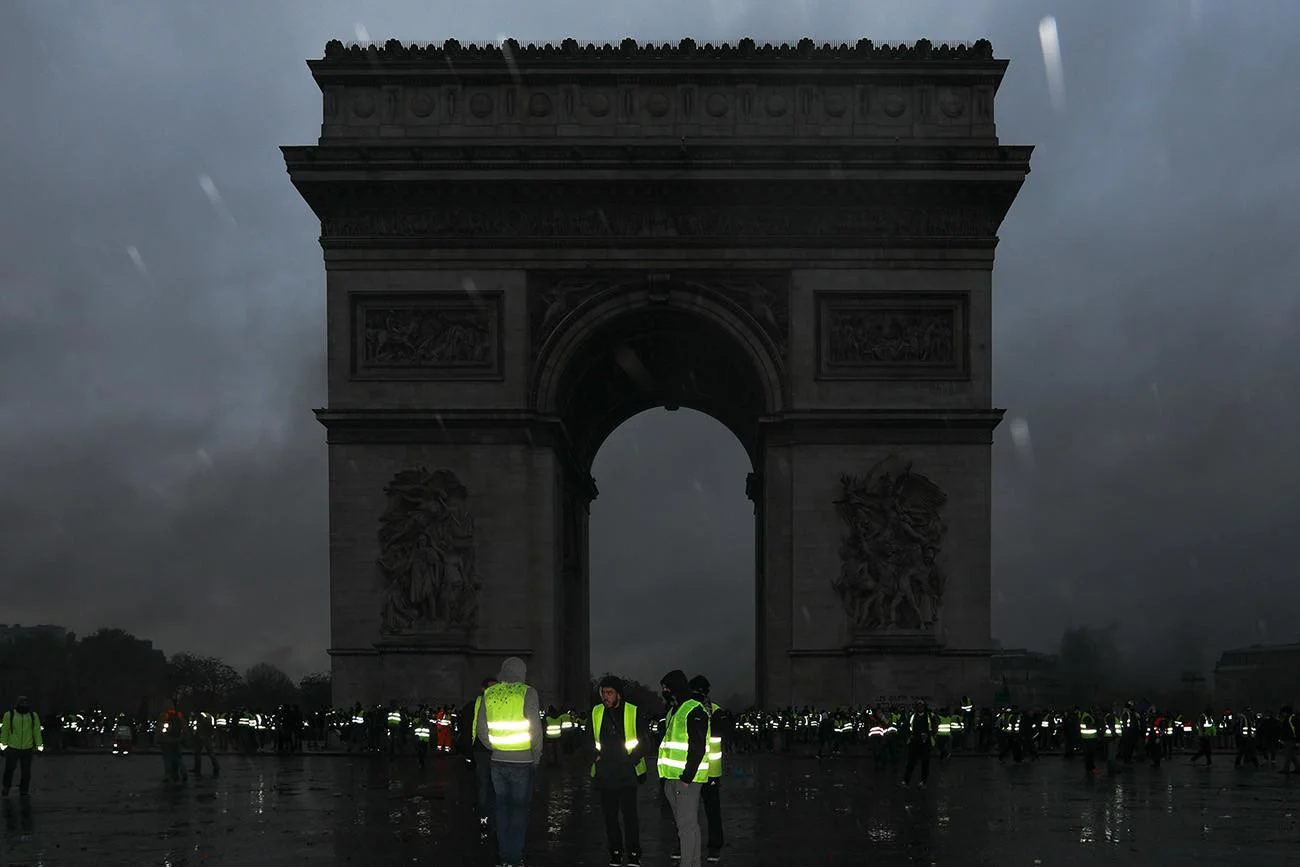
From this perspective, the Constitution of 1793 could clearly be seen as an act of capture, carried out amidst a revolutionary atmosphere marked by recurring threats from the sans-culottes against the Convention, the storming of the Tuileries Palace, and the deposition and subsequent execution of the king. Such a tour de force is always, at the same time, an admission of weakness. The act of restoring the institution to the center of politics and the state to the heart of decision-making simultaneously acknowledges the temporary loss of a monopoly over civic life, and thus its own contingency: no, power is not natural, and its legitimacy is not heaven-sent. This is even more true in the case of the Constitution of 1793: power acknowledges its inherent tendency towards tyranny, which in a sense heralds the possible outbreak of further uprisings. Some may consider this an end in itself; however, sometimes one must know how to lose in order to win — just as it was necessary to kill the king to save the monarchical principle and enable it to enter the constitutional realm of power. Institutions embody the sovereignty of the people, marking the moment of their transition from subjects to objects of their own history. The Yellow Vests were this “people” who were theoretically sovereign, but objectively and subjectively marginalized. Raised on lies, they learned to believe in them, to the point of rising up to demand their fulfillment. The specter has entered the house; it will never cease to haunt it. The insurrection remains a force even after its suppression.
Of course, we cannot overlook the defeatist nature of these ramblings. But the example highlights a dialectic of the institution: much like the bureaucratization from below following the 1917 revolution, in which the poor and the exploited discovered freedom of speech whilst generally being unable to read or write — so too did modern subjects, the citizens, experience horizontality, which they regarded as the only valid and therefore genuine form of democracy. This experience ran up against a republican regime that was heir to the monarchical principle, whose entire history is one of struggle against the self-determination of the poor, and which exists in everyday life as a separate sphere — this is the question of privileges — and an oppressive one — this is the question of the police and taxation.
Criticism of the institution as a form that captures the power of the world and confines it within a series of specialized questions and processes was already present in embryonic form during the French Revolution, which propelled humanity into the modern era. This took the form of a demand for a bottom-up overhaul, a major reform intended to open up new possibilities. This demand was echoed in the Yellow Vests’ call for a Citizens’ Initiative Referendum, and for the resignation of the government and the president. Of course, in 2018 just as in 1793, this did not happen. And it is a safe bet that it will not happen in 2027 either, should France Unbowed come to power — we trust in Chile to have marked out the dead-end paths of left-wing strategies.4
(Article 34) There is oppression against the social body when just one of its members is oppressed...
We must learn to think against the teleological tendency in history, which judges events solely on the basis of their outcomes. Never has the attack on the foundations of power been as fierce and grand as during the French Revolution. We are still living with the consequences, as Zhou Enlai once told Henry Kissinger (having misunderstood him).5 For it was the French Revolution that invented representative democracy as the model of society that would dominate the next two centuries. And it was the French Revolution that likewise sowed the seeds of its own potential overcoming: the idea of a history freely shaped by and for humankind. People will not fail to create new counter-institutions — which may or may not become institutions in their own right — and to destroy them in order to better “pursue the madness of the movement elsewhere.” This same madness is inherent in the young Marx’s approach, which Kostas Papaïoannou described as a “vast undertaking aimed at freeing man from that which is not himself, teaching him to make himself in and through his real relations with the world, emancipating him from the transcendent chimeras that obscure his mind, make him a stranger to his own life, and prevent him from recognizing his own truth.”6


The Constitution of 1793 crystallized the hypothesis of destitution, thereby inscribing itself within the long history of the modern era that now confronts us. A perpetual insurrection against the cold machinery of the state, against fetishes and hierarchies, was thus embedded within the seams of the new authority. Cast within the symbolic sphere of a foundational text from the past, it may still be capable of becoming a material force during uprisings. Like an insult to the faces of the gods who had arrogated this long history to themselves, it announces a usage of political violence inherent to the new social contract, like a thorn in the side of all self-separating sovereignty, a contradiction that power cannot get rid of. In the final analysis, to enshrine the insurrectionary principle in a constitution, to make it central to how it projects the legitimacy of its power as a historical unfolding, contradicts any notion of the end of history: as long as there is power, there will be insurrections; we shall live communism. And although state powers have never made good on their controversial constitutions, its enemies held up their end of things through successive conspiracies and uprisings. Think, for example, of how the Paris Commune was in fact the culmination of a longer sequence extending from the July Revolution of 1830, the Canut Revolts of 1831 and 1834, the Springtime of the Peoples of 1848, the many smaller workers’ uprisings in Paris, the little-known Provençal peasant uprising against Louis Bonaparte's 1851 coup d’état, and the uprising against the Second Empire in 1870.
It falls to the revolutionary camp to articulate its negative stance, its categorical refusals, that unsolvable element that persists in the hatred of power, in the tenacious rage to radically transform the world and give to it a new language. There is no question of teaching humanity how to live, that is to say, how to make use of the world: it will manage that very well on its own. To enable it to do so, we must destroy all that destroys it, dismantle all that alienates it. Only then will the power imprisoned within the logic of the institution be revealed and unleashed.7
(Article 34) When the social body is oppressed, there is oppression against each of its members.
The Yellow Vests movement undoubtedly lacked a revolutionary subject forged through the struggle, one capable of transcending the vague signifiers that came to replace the proletarian “historical subject” or “national subject” of the people, or even the nebulous demands for social justice and improved material conditions that have become the norm in uprisings. They remained stuck to the category or signifier of “the people,” to the point of becoming its conscious and active embodiment: “Here we are!,” shout the mobile crowds of this “missing people,” among whom the pride of laborers — “For the honor of the workers” — remains an essential and pervasive unifying force despite the decline of Marxism and the communist parties, and who never abandoned their dreams of a “better world.” This “Here we are!” could also express a temporary sense of belonging, built upon struggle rather than upon a forced and detached objectification of the living movement. Still, new words were lacking to give shape to the much-desired transformation of society, which was reduced to its vaguest and most imprecise formulation: “For a better world.” A qualitative milestone was undoubtedly reached in the self-determination of the movement’s partisans as “Yellow Vests”: crowds came together as an active mass, forged their own political identity, developed original forms of assembly, deliberation, and decision-making, and sought — through petitions, grievances, the call for referendums, the “assembly of assemblies” — to formulate the beginnings of a project to transform society, which ultimately failed to take a revolutionary turn, but which was at the forefront of a new epoch.
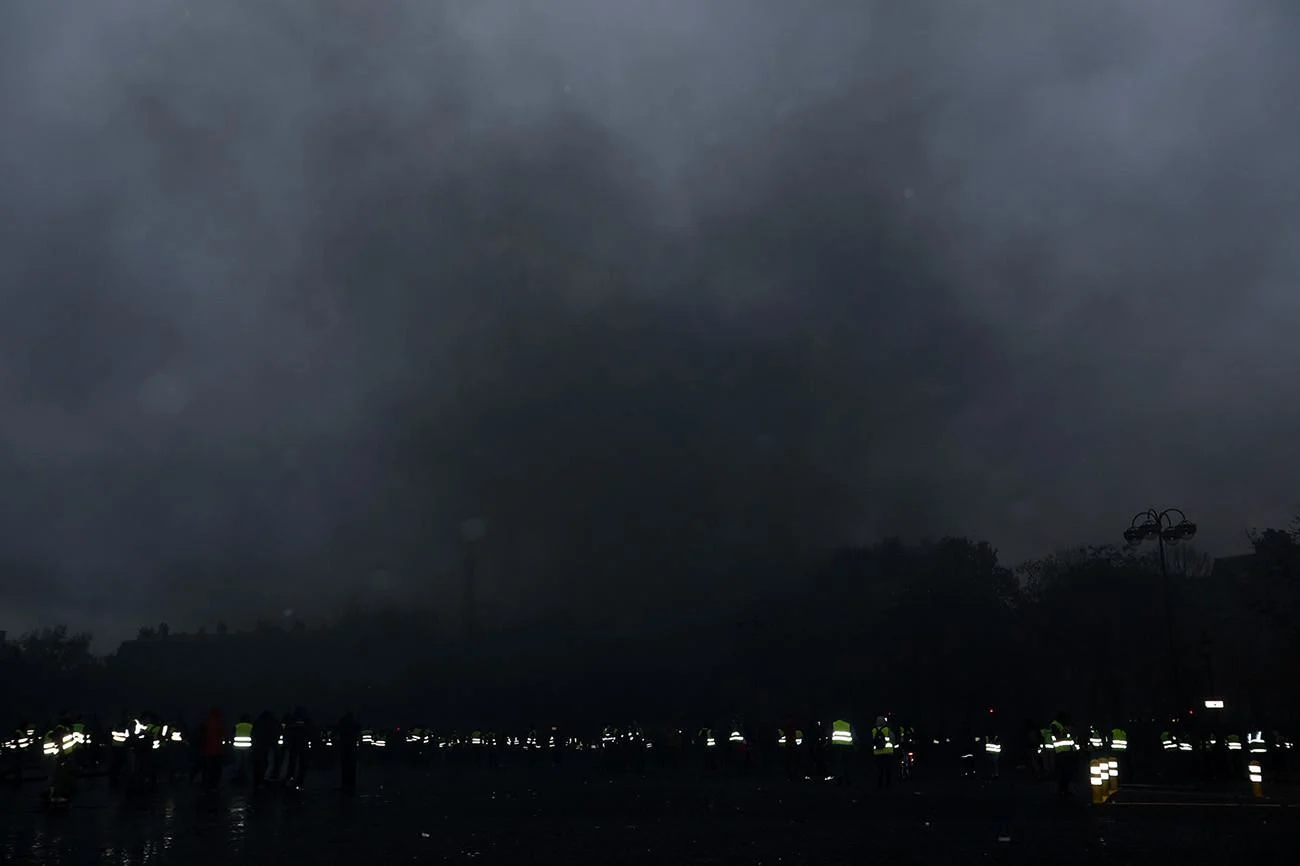
Within this vague identity, itself an unlikely mixture of fragments drawn from national, revolutionary, and republican identities — we see a new manifestation of the old adage that emancipation follows the path of alienation: the system’s fetishized categories (nation, people) and its places of non-encounter (roundabouts, weekends), its fundamental legitimacy (popular and fiscal sovereignty), and its blurred identities are simultaneously claimed, reappropriated, and shattered, forging thereby a form of transitive affiliation that unites, strikes, and permeates consciousness without locking it into a political project. The enduring failure of all the figures and groups that emerged in 2018 to confer a political meaning upon their belonging offers a powerful demonstration of the ephemeral and localized nature of the “historical mass” character of the Yellow Vests. These partisans of a new kind have thus subverted, or at least diverted, the very foundations of their passive participation in the social order, temporarily emerging from the nonexistence to which they were assigned, ceasing to be the unwitting servants of a war machine that has become so all-encompassing that there is now no one left to feel guilty or even responsible for anything.
This could be interpreted as a positive sign for the future: proof of insurgents’ ability to articulate temporary affiliations that suffice to confer a language and a spirit upon acts of rebellion, yet without giving rise to a constituent formula that would automatically reproduce all the uncriticized aspects of the old world. One might also fear, as in the case of the Chilean uprising, the Arab Spring, or even the 2023 movement in France8 and the recent “Gen Z” wave, that the inability to formulate such a sense of belonging, and to sustain it over time without reifying it, will lead to the same deadlock: an insurrection that fails to articulate a positive project, struggles to identify its adversaries at their root, and ultimately falls into lethargy and loses its momentum, leaving it to the state, the old political elites, or even the left to reformulate a constituent project that thrives unhindered on the vacuum created by the revolt. For the time being, the 2018–2019 movement is perhaps the most advanced draft yet of a partisan formula capable of breaking through the systemic obstacles of recent cycles of struggle; but it also displays all the contradictions of those previous cycles, and we must bear this in mind so as not to turn it into a comforting reference point that we invoke to stifle criticism rather than to initiate it.
This formula of ephemeral and irretrievable affiliation forces a question: is it possible to build a revolutionary force without a revolutionary subject? Once again, there is no question of theorizing a subject in advance in order to entrust the burden of history to it; the question is whether a subject can emerge in and through the struggle, at the end of a process of objectification that would make it possible to recognize its own strength and lay the foundations — the forms of organization, the language — of a new world. Some might say that the strength of the Yellow Vests lay precisely in the immanence and evanescence of its subject, which in turn made it impossible for the movement to be co-opted. Indeed, the power of the Yellow Vests was not channeled into reinforcing the status quo, restoring the legitimacy of power, or modernizing the productive or institutional apparatus. Instead, as with all defeated uprisings, it served as a pretext for an escalation of repression. But whether through partial integration or total repression, it would be wrong to forget the greatness of all that has been crushed and put the defeated of history on trial for collaboration.
Recent uprisings teach us that the lack of a distinct language and a positive vision now constitutes the main obstacle to revolutionary action, and perhaps even to revolutionary thought itself. The revolutionary camp must confront this contradiction by taking the bull by both horns: on the one hand, by identifying the negativity still at work in society; on the other, by bringing to the fore revolutionary potentials that reach beyond the powerlessness of the present, with its lack of a rallying cry, the obsolescence of its past, and its nostalgia for the working class and its historical mission. In short, we must recognize that the hypothesis of a history free from all fetishism — history conceived as a conscious creation of humankind — must twist free from its origins and become pure negativity in order to be able, one day, to formulate a positive project for humanity.
1793 has already taken place. One more effort.
August 4, 2026
Translated by the authors and Ill Will
Images: Nathalie Bauer
Notes
1. This text aims to develop further the reflections offered in the article “Toward a Politics of Destitution,” published by Ill Will in October 2025. It also expands upon lines of inquiry explored in the “Interregnum” trilogy, penned in the wake of Emmanuel Macron’s dissolution of Parliament in June 2024 and published by Lundi Matin. ↰
2. [La France Insoumise, or France Unbowed, is a left-wing political party launched in 2016 by Jean-Luc Mélenchon, who is currently running for president. —Trans.]↰
3. “Marxism was not based on Marx’s theory, but on the state that had appropriated it. That state, the Soviet state, was based solely on one revolution — the Russian Revolution of 1917 — of which it had been the bloody defeat. The Russian Revolution had necessitated the Russian counter-revolution; the opening of a contest over the world in 1917 had necessitated its Marxist suppression in 1921. Among other counter-revolutionary measures, the Bolsheviks had organized society into classes, isolating, controlling and paralyzing the majority of Russia’s modern poor within the Russian working class, which had not existed at all previously. The beginnings of this organization had already been undertaken in the rest of Europe, where a working class had already taken shape, albeit in a less Stalinist manner than that adopted by Lenin in Russia against the revolution, and which was subsequently applied to the rest of Europe in a Leninist manner by Stalin. Ever since the German workers rose up on Stalinallee in Berlin in 1953, the poor have, by every means possible, fought against, deserted and dissolved the working class, despite the efforts of their enemies. And in fact, it was not Marxist ideology that founded and sustained the working class; it was the working class that founded and sustained Marxist ideology. Now that the poor are no longer organized into classes (nor organized at all, for that matter), Marxist ideology, having lost its foundation, is collapsing. The Iranian Revolution proved, in the context of the Iranian counter-revolution, that the ideology which had stifled the debate in 1917 is no longer sufficient to stifle the debate on humanity.” Anonymous, Bibliothèque des émeutes [Library of Riots], Bulletin No. 1, April 1990.↰
4. “All emancipation is a reduction of the human world and relationships to man himself. Political emancipation is the reduction of man, on the one hand, to a member of civil society, to an egoistic, independent individual, and, on the other hand, to a citizen, a juridical person. Only when the real, individual man reabsorbs into himself the abstract citizen, and as an individual human being has become a species-being in his everyday life, in his particular work, and in his particular situation, only when man has recognized and organized his ‘own powers’ as social powers, and, consequently, no longer separates social power from himself in the shape of political power, only then will human emancipation have been accomplished.” Karl Marx, “On The Jewish Question” (1843). Online here. ↰
5. [As the story goes, around the time of Nixon’s visit to China in 1971-72 Henry Kissinger asked Zhou Enlai what he thought about the impact of the French Revolution, to which Zhou replied that it was "too early to say" — implying a long view in which historical events remain unfinished even centuries later. However, Nixon’s interpreter later clarified that Zhou was referring to the more recent uprising of 1968, rather than the eighteenth century revolution. —Trans.] ↰
6. Kostas Papaïoannou, Hegel, Tri Thuc, 1966. ↰
7. “Today, however, we see no such human content, no higher symbolism, no “sign” in which we might recognize ourselves as a whole, in a state perceived as an impersonal and terrorist machine rather than as a tragic problem. In our attitude toward the modern state, which tends to transform the whole of society into a labor and ‘re-education’ camp, there is a lack of the element of ambivalence on which the tragic is founded: between ourselves and the state, the only relationship of which we can become aware is, quite simply, its total negation. ‘There is no concept of the state,’ Schelling wrote to Hegel, ‘for the state is something mechanical, just as there is no concept of a machine.’ And yet, I believe there has never been a time before now when power has been to such an extent the sole category through which society has conceived of itself in its entirety, and when power has simultaneously taken on the all-encompassing and oppressive dimensions of a ‘fate.’ Never before has the oppressive machinery of the state been so sophisticated, nor has it been wielded against populations as passive as they are today. Never before has the domination of men over men had at its disposal such effective means of oppression — materially, technically, organizationally, and ideologically — to the extent that they render impossible, and at times unthinkable, the exercise of any control ‘from below.’” Kostas Papaïoannou, Mass and History, Eterotopia, 2003.↰
8. [On this movement, see for example Maurizio Lazzarato, “The Class Struggle in France,” translated by Eric Aldieri, Ill Will, April 15, 2023. Online here. —trans.]↰