From War Between States to Class War
Maurizio Lazzarato
In the following text, Maurizio Lazzarato argues that the wave of uprisings spreading across Europe announces a turning point wherein the war between states returns home as class war. As global debt becomes a priori unpayable, and the profits once secured by credit and finance have all but dried up, militarism and imperialist predation return to the forefront to shore up accumulation. Seen in this light, Macron was merely the faithful executor of the logic of the times: governing by decree, dismantling public services, and turning the police into an anti-insurrectional force. Although the mounting insurgency has so far managed to leap over the racial and generational oppositions by which the ruling class has sought to divide it, Lazzarato argues that capitalism will not fall of its own contradictions but only through the emergence of new modes of organized class combat capable of shifting the balance of power between states and classes on a global scale. The alternative is not peace or war, but “socialism or barbarism.”
Virtually all commentary on the uprisings beginning to sweep across Europe (now including Austria, too!) is written as if they were not taking place in the midst of a “piecemeal” world war, in the terminal phase of the debt economy, and, consequently, of American hegemony — in a world where we’re going to sizzle like filets on a barbecue, within democracies that arm, finance, and legitimize genocide by unleashing thousands of bombs and drones against all those who refuse to submit to the West’s renewed armed imperialism and colonialism.
Let’s try to take a step back from current events to grasp the big picture of a class struggle that is finally erupting with an intensity comparable to the war waged by bosses and elites: le “fond de l’air n’est plus rouge” [the “air is no longer red”]1 as it was in the 1960s and 1970s; if anything, it has the brown and black hues of the counterrevolutionary shirts of a century ago, even if these colors now blend together with those of liberal “democracies.”
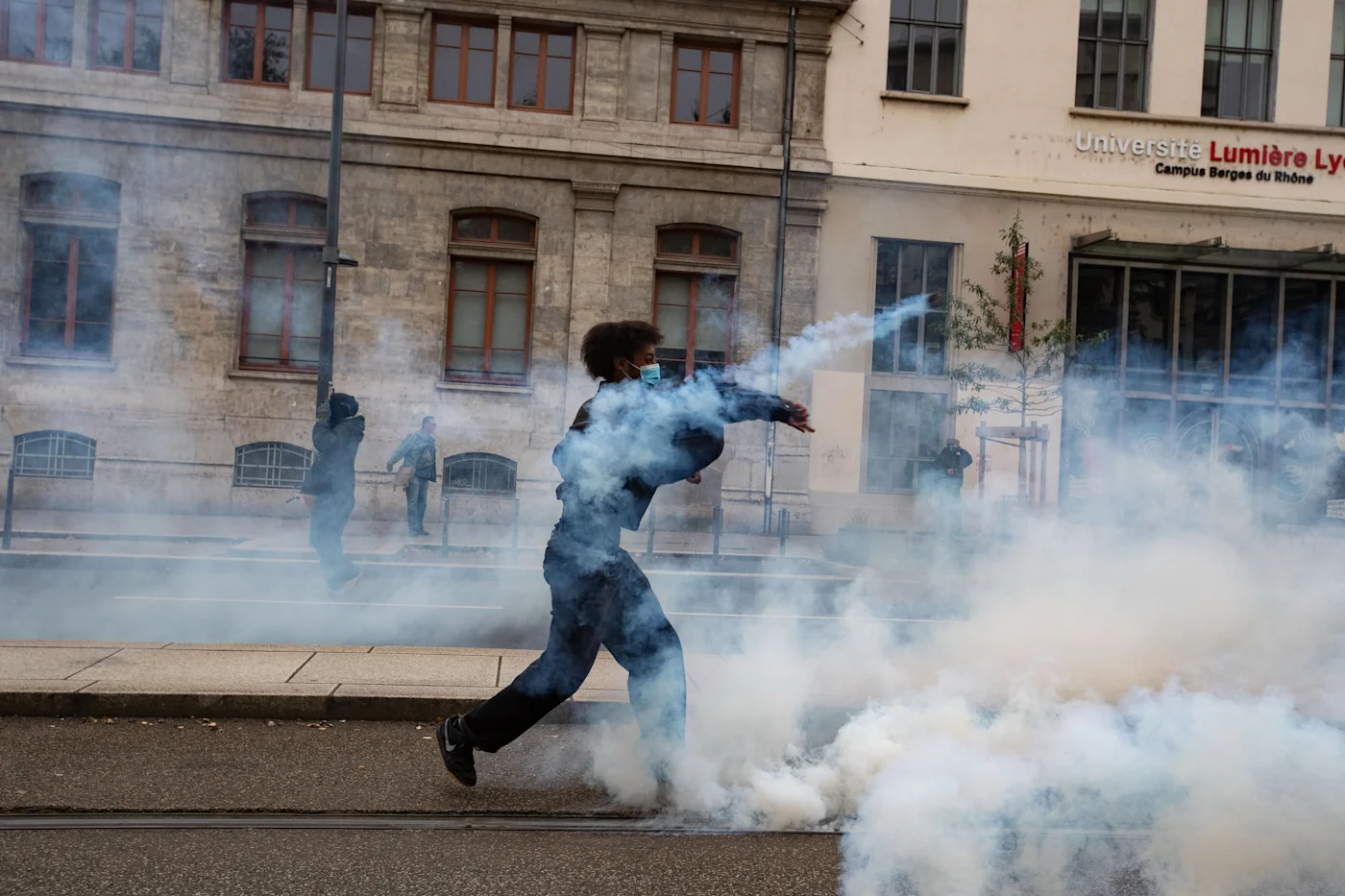
Many young people in the streets on October 17 wore yellow vests to assert their continuity with the 2018 movement of “poor” workers, or those swiftly descending into poverty. Many aspects of the October 17 protests point to the radicalization of this movement. The demonstration no longer followed the orderly, boring, and predictable marches of the unions and the institutional left, which ritually wind their way from République to Nation in eastern Paris. Instead, it spread throughout the city, branching out into “spontaneous” processions and penetrating, on the other side of the capital, the neighborhoods of the rich and powerful, leaving the privileged in a state of shock (“How dare these good-for-nothings?”).
This city, plundered by the real estate rents of major investment funds and transformed into a museum and an amusement park for tourists, passed for a few hours into the hands of a seething mass of proletarian forces; for a moment, even as the fumes of tear gas hung in the air, it was suddenly easier to breathe.
The proliferation of protests targeting affluent neighborhoods represents a significant shift introduced by the Yellow Vests. But October 17 also marks a break from the struggles that emerged in 2011, following the subprime crisis, and in the years that followed (in France, the protests against the Labor Law, the banlieu uprisings, the protests against raising the retirement age, etc.), because these mobilizations are now taking place in a time of war and within a war economy.
“This is only the beginning”: the war between states — which had been foreseeable since shortly after 2008 and has been raging for several years now — is resurfacing in various countries in the form of a class war, ushering in a new political phase that is likely to last a long time.
Imperialist war constitutes a historic rupture, a turning point that redefines the entire balance of power not only among states but also among classes. As in the 20th century, it took several years for the consequences of the armed conflict on the global market to be felt at the local level. Relations of domination and exploitation between the ruling classes and the proletariat are intensifying; the costs of the arms race are borne by the proletariat, while calls for enlistment in the war against Russia are multiplying. The ruling classes are in the process of establishing a new framework within which the class struggle is unfolding and will continue to unfold.
War imposes a political acceleration very different from technological acceleration. It is within this context that the fate of capitalism is being played out, in a situation where political tactics and strategies must be adapted to the level of the ongoing conflict. The theories and analyses developed over the past fifty years have suddenly become outdated and unusable. Finally, with the emergence of a subjectivity that was previously lacking, it has become possible to move beyond the limits of “weak” critical thought and a geopolitics that reasons solely in terms of state power, and to speak once again of class struggle.
We cannot ignore this epochal shift and the stakes it entails — of which states and the ruling classes are fully aware: war is the ripe fruit of imperialism’s contradictions, but the latter manifest themselves in the form of oppositions and strategies that are adopted and constructed subjectively. It is not possible to desert the war — an illusion that perpetuates the naivety of an “exodus,” an escape that has never existed. On the other hand, it is possible to begin thinking about the possible end of capitalism, which will not come about as a result of its internal contradictions, but solely through the political will of those who organize to overthrow it. We thus move beyond, in practice, the idiotic cliché propagated by many — notably Fisher and Žižek — that “it is easier to imagine the end of the world than the end of capitalism.” Capitalism is disintegrating before our eyes, but it will only be brought down by a political initiative.
Let us briefly retrace the historical shift we are currently experiencing, for it will provide us with at least two frameworks within which the class struggle is unfolding and will continue to unfold over the coming years: war and finance. The crucial moments in the mode of accumulation that is now failing are: first, in the 1970s, when hegemony within capitalism shifted from industrialists to financial capitalists; second, today, when the failure of the financialization of the economy finds no other solution than war.
We should speak of a “debt economy” rather than a “financial economy,” because it is through debt that we can articulate the creditor-debtor relationship, which reveals the subjective perspective and the political will driving this new form of class conflict.
The composition of the proletariat has always been multifaceted: class, gender, race. In industrial capitalism, it was subsumed by the capital-labor relationship; in financial capitalism, it is subsumed by the creditor-debtor relationship, which first completely destabilized, then destroyed the labor movement, and placed Marxism in great difficulty. What is in question is an “abstraction” that operates transversally across “classes,” constantly seeking to subsume them, yet never succeeding except partially. It constitutes an immense machine of predation, plunder, and pillage of all kinds of value: not only wages but, paradoxically, also industrial profits, non-wage income, savings, the state’s tax revenues, social protection, and so on. It thus complements the exploitation of labor described by Marx, domestic labor theorized by feminists, and servile labor found in decolonial thought.
For fifty years, a colossal transfer of wealth from the entire global proletariat to capital has been underway, producing polarizations that take us back to a time before the French Revolution. In this new form of capitalism, democracy was already considered, as early as the 1970s, to be incompatible with the accumulation of capital.
This model of accumulation imposed by the United States was replicated in a Europe entirely subordinated to American hegemony. France, like the rest of Europe, quickly bowed to this counterrevolution, whose inherent flaws are now plainly seen, making the ruling classes more aggressive and ferocious, ready to go as far as genocide to save Western “values.”
We are not witnessing the end of the “reign” of Macron — who governed like a “monarch,” in keeping with the nature of the new accumulation — but rather the end of financial capitalism. To label him incompetent, as certain establishment newspapers do in an attempt to distance themselves at the last moment, is a political mistake. His two terms in office have been a success in the sense that he carried through to its conclusion the logic of the economy of debt, rent, and the free movement of capital, initiated in 1983 by the Socialists. He destroyed public services (schools, healthcare, housing, etc.) in order to facilitate their privatization; he exempted the wealthy and corporations from taxes, shifting the tax burden onto labor; he transformed social protection into a system of assistance for entrepreneurs, who themselves were exempt from social security contributions on labor; he dismantled unemployment insurance; he continued to raise the retirement age, etc.
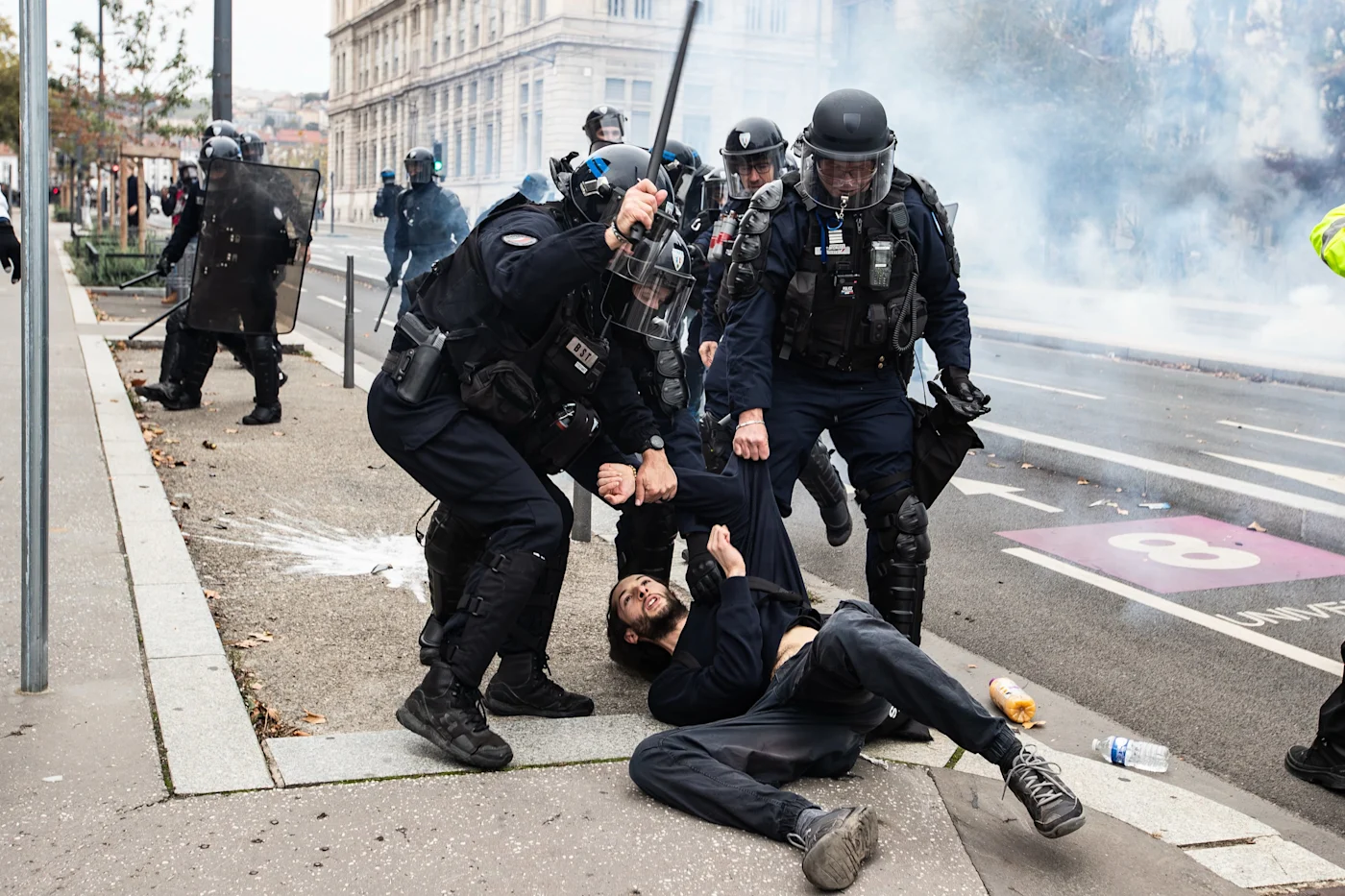
He governed exclusively by decree, concentrating all power and accentuating, if that were even possible, the character of a Fifth Republic that was democratic in name only, while transforming the police into an anti-insurrectional force. He severed all ties with the labor movement, fully aware, with unabashed cynicism, that if, thanks to his policies, the country’s 500 wealthiest families accounted for 6% of GDP in 1996, yet now account for 46%, then there is no room for compromise, and no dialogue with the movements’ demands is possible. He has done on a small scale (that of a provincial Europe) what the United States has done on a large scale.
Nor is he responsible for the explosion of French sovereign debt, as it is structurally embedded in the workings of financial capitalism. The total global debt (private and public debt combined) now stands at $350 trillion, or three times the annual global gross world product. Growing faster than the non-speculative economy, it is materially impossible to repay it, even by imposing decades of austerity on the global working class.
Debt crises have followed one another at an accelerating pace. After beginning in Africa and Latin America in the 1980s, they shifted to Russia, Southeast Asia, then back to Latin America, before reaching Europe with sovereign debt crises and the Greek crisis. They are now striking at the heart of the Empire. They have wreaked destruction and plunder across entire countries and economies. Each financial crisis leads to an even larger bubble, the bursting of which results in unsustainable costs.
As private and public debt reach record levels in the United States and the speculative bubble appears capable of growing indefinitely, the U.S. government and its ruling classes opt for war: since it is no longer possible to extract wealth through credit, debt, and finance, they will do so by force. Imperialist and colonialist predation compounds financial predation: power relations become mafia-like; armed force is deployed to seize gold and raw materials, demand tributes amounting to billions of dollars, and compel vassal states to relocate their industries to the United States.
With war, the destruction and self-destruction of the system become intertwined.
The situation of the European working class continues to deteriorate, as Europe remains a major loser in the conflict between the great powers. Policies of austerity, cuts to public services, and “wage moderation” are continuing and intensifying under the influence of the rearmament policies imposed by the United States, which has decided to plunder one of the richest regions on the planet by using it as an ATM. With the complicity of Europe’s political classes, the cost of the war in Ukraine, the energy crisis (a consequence of the sabotage of Nord Stream 2), and price hikes caused by the war against Iran will be borne by the European working class.
Refusing to touch a distribution of wealth that is more polarized than ever, Macron — and Europe along with him — claims to have not a penny left to respond to demands that will only multiply, and is preparing for social confrontation.
The police, the only possible response to the movements’ demands, embody better than any other institution the crepuscular power of the machinery of the state and capital. Walter Benjamin had already noted this in the 1920s, as fascism was brewing:
“[T]he police intervene ‘for security reasons’ in countless cases where no clear legal situation exists [...] The ignominy of such an authority…lies in the fact that in this authority the separation of lawmaking and law-preserving violence is suspended. [...] It is lawmaking, because its characteristic function is not the promulgation of laws but the assertion of legal claims for any decree, and law-preserving, because it is at the disposal of these ends.”2
Its strength and power are multiplied in the genocidal democracies of declining financial capitalism, where the liberal separation of powers is practically abolished in favor of the executive branch alone. It is within this continuum between democracy and fascism that the police “bears witness to the greatest conceivable degeneration of violence.”3
The subjects constituted through struggle are not recognized as political subjects. Nanni Balestrini wrote a book, The Unseen, dedicated to a generation. Today, all classes and social groups within the proletariat are rendered unseen, despised, and made to feel guilty. Even when they revolt, they are not taken into consideration, for conflict, in all its forms, has been criminalized. In the 1970s, the ruling powers declared that there was no alternative, not even an institutional one. As Greece was being plundered by its creditors, Wolfgang Schäuble, the German Minister of Finance at the time, laid the situation out clearly: “elections,” he stated, “cannot be allowed to change economic policy.”
Caught between the present stagnation and the recession to come, foreign war and domestic civil war, the financial crisis and the climate crisis, struggles are rising up against this despotic future marked by imperialist impoverishment, colonial servitude, and promises to reinstate military conscription.
France has a long tradition of struggles, including recent ones, that have mostly ended in defeat. Since the 1970s, it has no longer been possible to establish a balance of power favorable to the proletariat. Struggles, even fierce ones, have too often been defensive. The present movement seems to open up a new horizon: “quitter l’époque contemporaine” [“exit our current epoch”].
The current movement has functioned, far more so than the Yellow Vests, as a force of recomposition, mobilizing the subjectivities that had driven previous struggles. These struggles, even when defeated, left behind them a legacy of experiences, techniques for mobilization, demonstration savoir-faire, and demands that in concrete and tangible ways, came together on October 17, regardless of whether the participants were aware of it.
The Yellow Vests’ struggle, the “Nahel generation,” and the fight against pension reform have accumulated deep resentments and frustrations because they received no response, nor any interlocutor. Capitalism, which is deliberately non-dialectical, cannot provide this response, while the interlocutors refuse any mediation, aware that the balance of power favors it.
The movement has so far managed to circumvent the racism of the state, which had infiltrated even the “left” during the debates surrounding the “headscarf” worn by Muslim women. The racial divisions by means of which ruling institutions had hoped to split the proletariat have been overcome in practice: the high school students’ movement began in territories overseas — what remains of the French colonial empire — then took root in the metropolitan suburbs, before spreading to city centers.
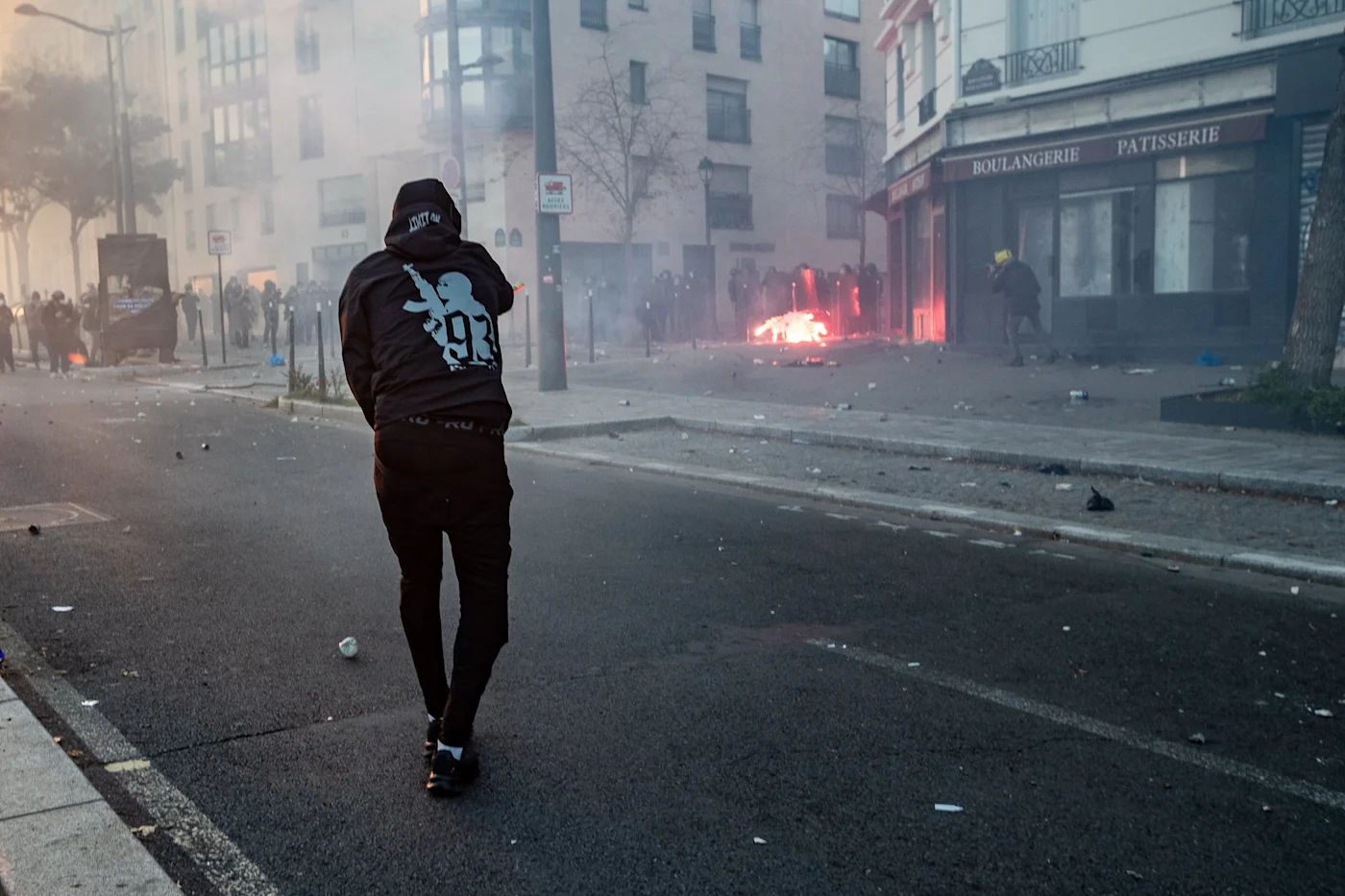
It will be more difficult to mobilize what remains of the labor movement, which, under financial capitalism, has not played a role in anticipating and mobilizing since at least 1995. It is incapable of taking root in the new forms that the labor force has taken on. A prime example of this is the mistrust, even hostility, of the unions toward the fragmented, precarious, and low-wage labor embodied by the Yellow Vests.
The strike called by the mayors’ unions on November 5th will not give way to a “workers-students” alliance but to something different, which we saw on the streets on October 17: the presence of the multiplicity of living and working conditions of the contemporary proletariat.
The ongoing genocide of the Palestinians, armed and legitimized by democracies, has played a fundamental role in the current mobilization. It shifted the balance of power not only between states, but also by sparking contestation from below that is now spilling over into domestic politics around war, albeit with a certain time lag.
The mobilization in support of Palestine has brought the issue of imperialism and colonialism, often absent from European struggles, back into the spotlight. It exposed the ferocity and pitiless violence of today’s democracies, who built their power, their rights, and their social welfare systems upon the exploitative relationship between the center and the periphery. It is precisely the horror perpetrated in Palestine that has rooted the awareness that this democratic-capitalist system cannot be reformed.
The subjective reconfiguration of the many divisions through which capitalism and the state had split the proletariat now faces a new political task, one that is far from easy: to grasp the shifts in the balance of power brought about by the ongoing imperialist conflict, which can dictate the terms of local struggles, while at the same time developing a political response to these transformations.
The moments when movements were consistently defeated always coincided with an extreme intensification of conflict, when power had to be confronted as a “totality.” Not only in France, but also, for example, in Egypt or Chile, defeat occurred when the intensity of the struggle had surpassed the demands that had given rise to it and brought to light the need for a radical alternative. The issue remains entirely open.
In the political phase ushered in by war, the alternative is not between peace and war. For the opposing powers, the stake is not a return (objectively impossible) to the pre-war situation, but a redistribution of power relations between states and between classes, and achieved by force.
“Peace” will be that of the victor, and will not mean the absence of war. For a movement that goes to the root of things, the concrete and real alternative is not between unilateralism and multipolarism, but — as always in times of world war — between “socialism or barbarism.”
After fifty years of constant economic and political regression, we are now experiencing a new qualitative leap: the ruling classes preparing for war against Russia continue to flaunt their willingness to sacrifice the lives of others (a French admiral calls for “accepting the loss of one’s children,” and Macron speaks of acting “at the cost of blood, if necessary”) to defend the West.
High school students are at the forefront of those who could be sacrificed on the altar of Western values. They understand better than anyone that the future that elites are preparing for us will consist of war, genocide, police states, scorched earth, the integration of fascism into democracy, and slave labor. They also know that the future will be nothing other than what they manage to construct.
In France, an institutional alternative to moribund Macronism is taking shape. Will a revolutionary alternative — the emergence of a revolutionary subject that acknowledges the reality of the balance of power between states and classes on a global scale — be possible?
Postscript
A 1966 text by the Situationist International, dedicated to all the idiots who stare at the finger — the shop window — instead of looking at the moon — capitalism:
“Like the young delinquents of all the advanced countries, but more radically because they are part of a class without a future, a sector of the proletariat unable to believe in any significant chance of integration or promotion, the Los Angeles blacks take modern capitalist propaganda, its publicity of abundance, literally…The looting of the Watts district was the most direct realization of the distorted principle: ‘To each according to their false needs’ — needs determined and produced by the economic system which the very act of looting rejects. But once the vaunted abundance is taken at face value and directly seized, instead of being eternally pursued in the rat-race of alienated labor and increasing unmet social needs, real desires begin to be expressed in festive celebration, in playful self-assertion, in the potlatch of destruction. People who destroy commodities show their human superiority over commodities. They stop submitting to the arbitrary forms that distortedly reflect their real needs…Looting is a natural response to the unnatural and inhuman society of commodity abundance. Looting, which instantly undermines the commodity as such, also reveals the ‘ultima ratio’ of the commodity: the army, the police and the other specialized detachments of the state’s monopoly of armed violence.”4
Translated by Ill Will
Images: Emrah Oprukcu
Notes
1. A reference to Chris Marker’s film of the same name, which focuses on the movements of the 1960s. ↰
2. Walter Benjamin, “Critique of Violence,” translated by Edmund Jephcott, in Collected Writings Vol. I, edited by M. Bullock and M. Jennings (Harvard, 1996), 242-43. ↰
3. Benjamin, “Critique of Violence,” 243. ↰
4. Guy Debord, “The Decline and Fall of the Spectacle-Commodity Economy,” translated by Donald-Nicholson Smith, Internationale Situationniste #10 (March 1966). Online here.↰