Revolution, Dual Power, and the Twin Cities Rapid Response Network
Connor O’Callaghan
The following essay, first circulated by hand in zine format, examines the popular insurgency against Operation Metro Surge in Minnesota during the winter of 2026. In it, O’Callaghan argues that the Twin Cities rapid response network represented an embryonic form of dual power, a popular institution directly contesting state control of an urban territory. While the author’s characterization of the network as a “parallel police force” is perhaps debatable, the essay raises fundamental questions for revolutionaries who passed through this cycle of struggle. When the coalition that sustains ruling class control over a territory fractures (as when MPD and ICE entered into open conflict), when masses of ordinary people begin acting outside and against the law as a matter of course, the conditions for a revolutionary rupture begin to come into view. Yet, if such potentials fail to deepen and expand into broader antagonisms, it is decisive to understand the limits that keep them in check, particularly in view of the coming electoral crisis. As Trump systematically dismantles the mechanisms by which elites have historically managed their conflicts, how might revolutionaries intervene in these situations to ensure that they produce not just another round of rebellion, but forms of counter-power poised to step in when the liberal order finally breaks down?
Operation Metro Surge was the largest immigration enforcement operation in history. At its height, 3,000 DHS agents besieged the Twin Cities. January was so saturated with agents that it was impossible to step outside without encountering them. Over a hundred thousand Minnesotans organized a mass conspiracy against the federal operation. Each week, volunteers in a food delivery system fed thousands of families sheltering in place. Tenants with foresight and screwdrivers installed new locks on apartment buildings to keep out feds and landlords. Strippers refused dances to agents and bounced them out of the club. Soccer moms engaged in high speed chases on the freeway. Doctors made house calls to deliver babies. Teachers pooled rent money for their students. A nurse with a handgun kicked out brake lights. A cab driver patrolled sun-up to sun-down, searching for ICE. Youths in balaclavas made enemies of rental car tires. Children of the American Indian Movement distributed gas masks and wild rice soup. Grandmothers stood watch at elementary schools. Couches and spare rooms filled up when addresses needed to change. Immigrants dodged arrest by ducking into alleys and cutting through strangers' living rooms. Protesters did the same. En masse, people experienced themselves outside of, and against, the law.
Countersurveillance, high-speed chases, clandestine networks, encrypted communications, checkpoints, code names. When these things are normalized and taken up by masses of people, it is a qualitative leap forward for the insurgent struggle. This is the basis from which revolutionaries can advance.
There is no mechanistic formula to revolution, but there are particular conditions which give revolutionaries a strategic advantage. These conditions are not astrological, they are dialectical. They are forged from real decision trees by many actors working with, against, and through each other.
One of these conditions is the disaggregation of the ruling coalition. The establishment is not monolithic in its interests. Often they align, but many times they conflict and diverge. What ultimately matters to the different factions in the ruling class is that they can mediate their competing interests within a reliable framework. When that is no longer possible, when intractable differences arise and different factions employ irregular means to get their way, fissures open that popular forces can exploit to make revolution possible. Operation Metro Surge produced antagonisms between the state and federal government leading to the brief disunity of their respective armed forces.
Another early kernel of social revolution is the shifting allegiance of thousands of people in their actions. Nowhere was this more true than in the Twin Cities, where every conceivable kind of person participated. Resistance to ICE became the defining feature of life. While the aforementioned clandestine network helped people evade disappearance, the rapid response network (RRN) ascended as the confrontational vanguard of the local movement. The Twin Cities RRN was a simple way to interpellate large numbers of people into functional roles that directly challenged federal agents. Thousands of people learned that this was more effective than demanding something of authorities. Instead, they demanded it of themselves. This discovery is an essential precondition for revolutionary struggle.
What the RRN threatened to create was a dual power: a popular institution set up against the state, poised to usurp it. Dual power is not a “prefigurative” project nestled comfortably, but oppositionally, within the reigning order. It is one unstable arrangement of forces aggressively stifling another. It occurs when two competing political frameworks exist in the same place, at the same time, and only one can win. Such situations occur during revolutionary movements when the armed forces and political bodies of the ruling establishment are replaced by new institutions of the people's own direct initiative. The RRN was a massively participatory infrastructure that contested who controlled a specific urban terrain. It was essentially a parallel police force of a mass partisan character.
While the RRN never realized its full potential, it was an actually existing project that revolutionaries should study carefully, in order to orient our future struggles. Such formations transform reflexive expressions of refusal into purposeful struggles for power. This allows them to facilitate the leap beyond rebellion and toward the mass reorganization of society, which marks a revolution.
The rapid response network
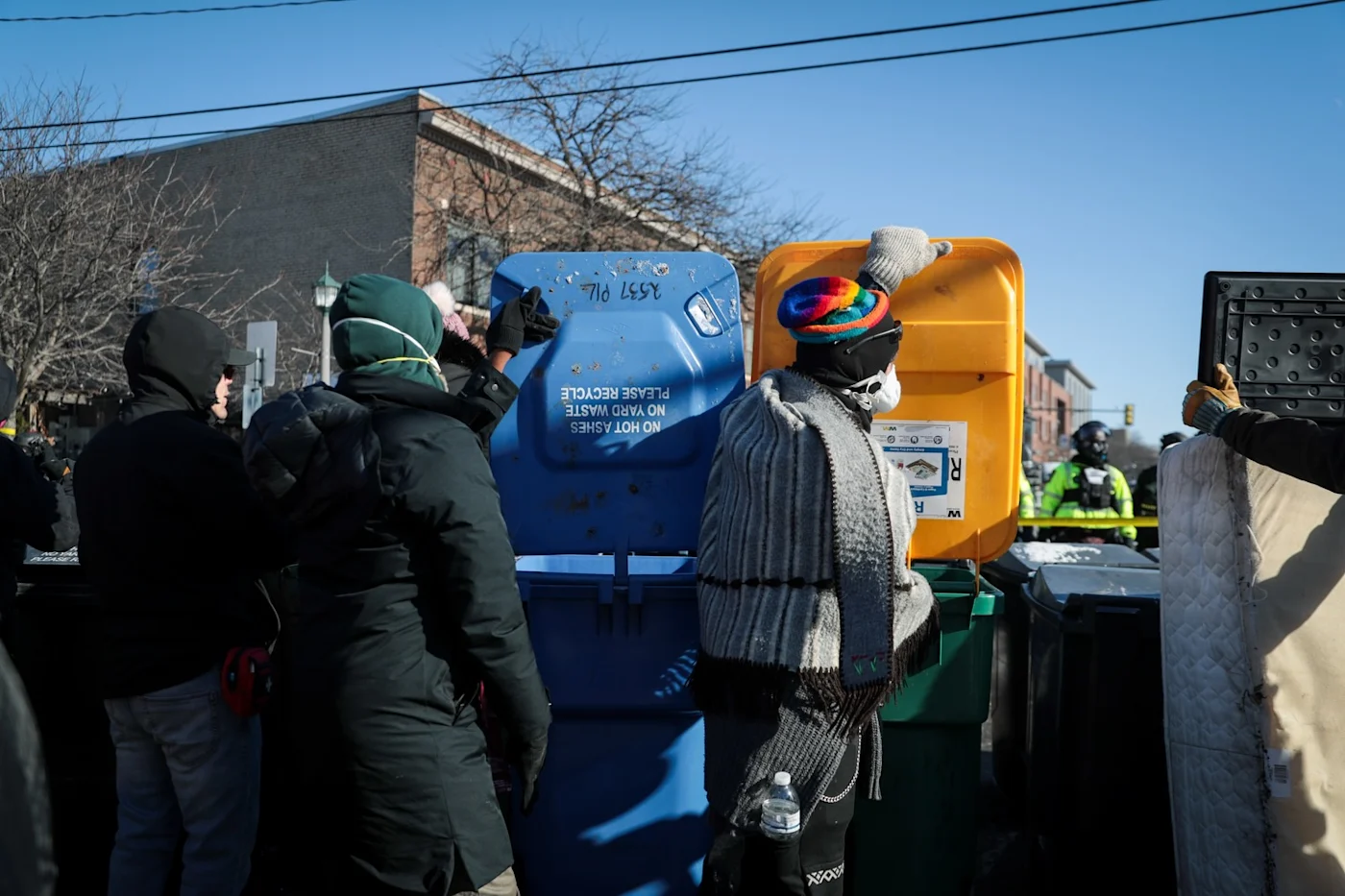
The Twin Cities rapid response network formed as a counterintelligence operation to stop Trump’s Gestapo. Daily stations at ICE headquarters recorded vehicle plates, descriptions, and convoy deployments, compiling this information into a public database of thousands of vehicles, marked "confirmed-ICE," "highly suspected," and "not-ICE." This information wasn't gathered for the abstract goal of raising awareness or documenting atrocities; surveillance data was adversarial insofar as it was operational. Rather than wait on standby, patrollers used this intel to track down agents and confront them directly. By doing so, the RRN became the most militant, as well as most popular way, to participate.
The whole metro area was divided into neighborhood zones. Each zone ran a tightly organized daily, daylong patrol call. In two-hour long shifts, remote dispatchers facilitated complete coverage of their zones. They conducted roll call, assigned routes, ran plate checks, timestamped ICE encounters, and relayed information between zones. Dispatch did not give orders; patrollers maintained a high degree of autonomy.1 The best dispatchers avoided conservative impulses; they encouraged discernment and bravery. Calls sounded like police scanners, only instead of the cops, it's a mom radioing dispatch that her route will be point-to-point, westbound on Franklin, as she picks up her daughter from school. Then, a retired couple asks to run a plate check against a suspicious vehicle they are following north on Hiawatha: "two male occupants, faces covered, in a red Jeep Cherokee with Nebraska plates. Dispatch, can we get a plate check for Bravo, Charlie, Papa, Zero..." The plates come back positive: confirmed ICE. The retirees continue in pursuit, and a nearby patroller radios that he is now headed eastbound as backup.
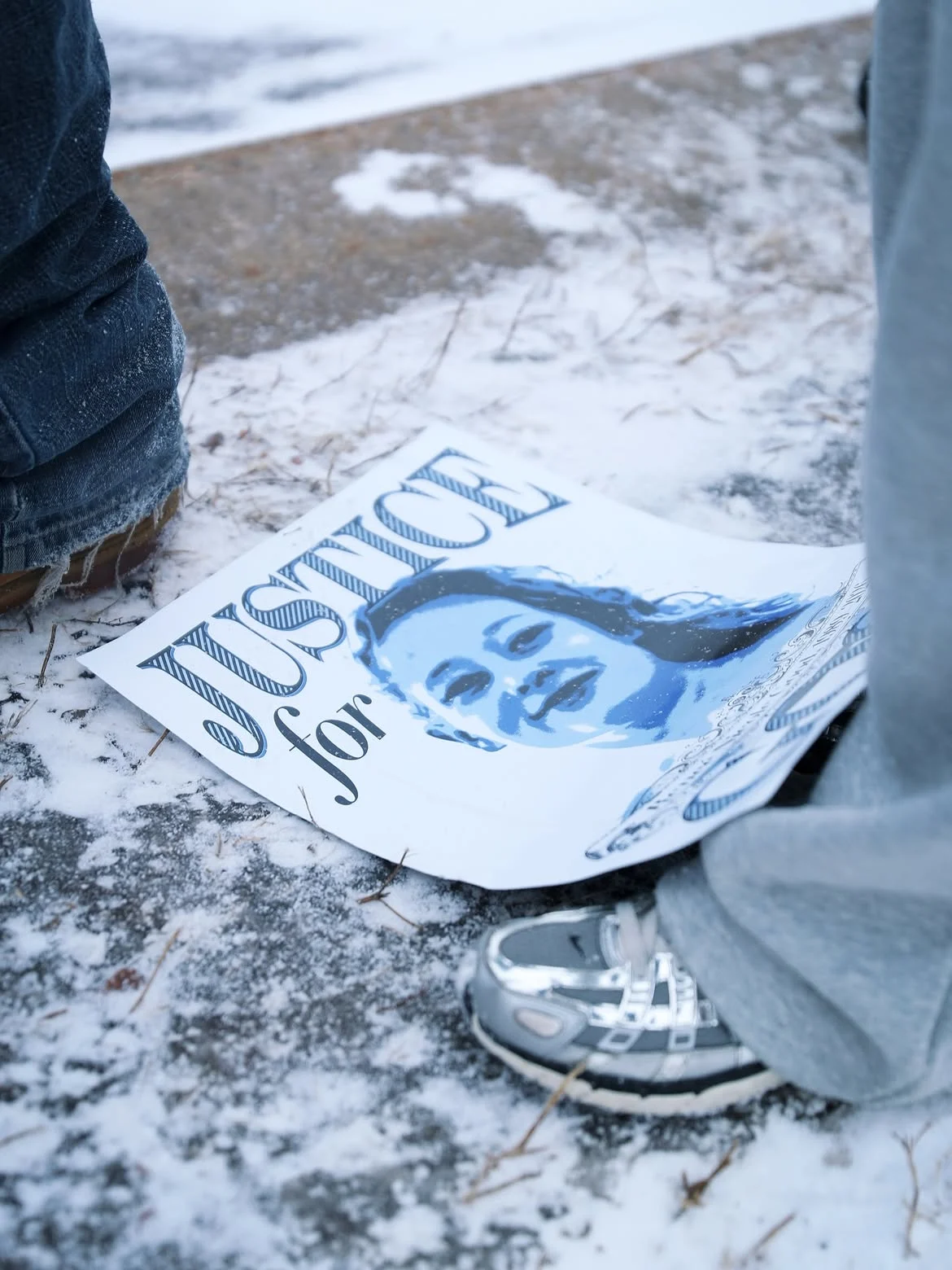
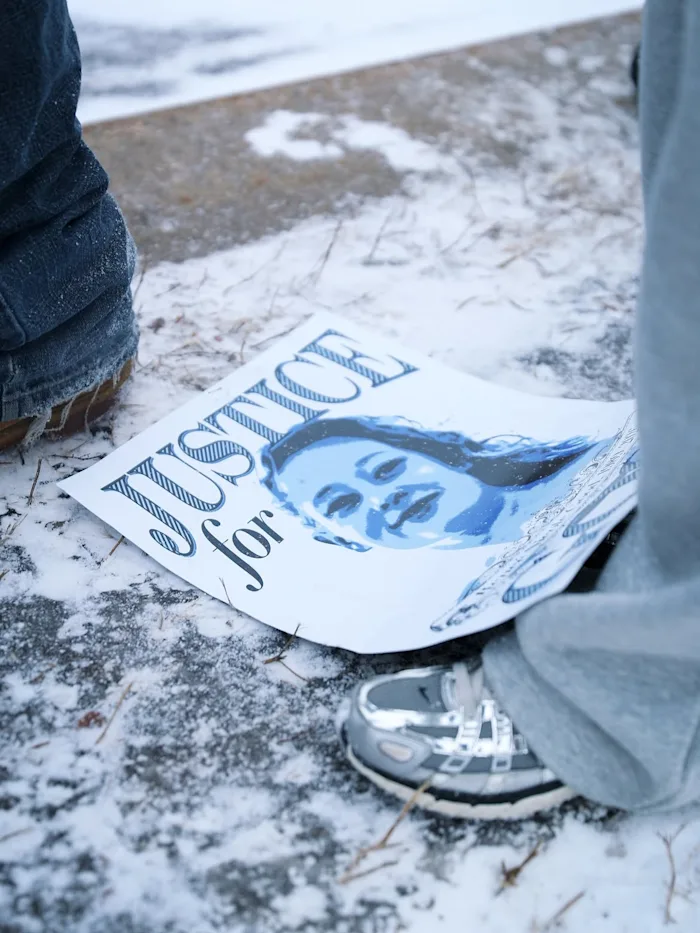
With a Signal account, the RRN was eminently joinable. Few basic skills were involved, and those that were, were teachable. In subfreezing temperatures, regular people carried out major historical tasks. At its best, the RRN made many ICE operations unfeasible by tailing agents before they could stage a raid. This led to frequent high speed chases and showdowns in alleys. It infuriated agents so much that they brake-checked patrollers, broke their windows, cut drivers out of their seatbelts, and threw them into snowbanks.
When they weren't being followed, agents compressed abduction time to seven minutes in anticipation of patrollers. In the densest neighborhoods of the resistance, ICE trained to get in-and-out in only a fraction of their already diminished timeframe. In Powderhorn, rapid responders often arrived in less than two minutes.
After two months, the RRN amassed a sprawling, open-source license plate database, using it to patrol the whole city with near-constant coverage. Movement infrastructure supported patrollers with free food and gas cards. Checkpoints started popping up as more confrontational foot patrols. The RRN did more than just force the question of who controlled the streets: by orchestrating a popular force hostile to the federal government, it provided an unequivocal answer.
Disaggregation of the ruling class
Dual power formations are often able to ascend by taking advantage of disintegrating established orders. This was certainly the case for the Twin Cities RRN. For a brief window of time, the ruling class was divided. Hennepin County instructed jails not to cooperate with immigration enforcement. More than a dozen federal prosecutors resigned from the Minnesota US Attorney’s office after Renée Good was murdered, leaving it two-thirds vacant. Federal Agents blocked MPD from accessing Alex Pretti's body. ICE racially profiled at least one off-duty police officer, drawing guns and demanding to see her immigration papers. As the chaos mounted, Border Patrol Commander Greg Bovino and Minneapolis Police Chief Brian O'Hara each pointed their fingers at one another. Mayor Jacob Frey went viral for telling ICE to "get the fuck out of Minneapolis," while Governor Tim Walz called it "a Nazi invasion." Trump called both men terrorists, and the Department of Justice charged them with criminal conspiracy to impede federal agents.
It's easy to reduce these spats to mere media spectacles. In some ways, they were. The White House and Minnesota Democrats were both begging to "lower the temperature." Still, it's not often that prosecutors, jails, federal and state politicians, the police, and DHS are so disunified. The most significant aspect of this conflict was that between MPD and ICE. Since one of its officers lynched George Floyd in 2020, the Minneapolis police department has desperately sought to rehabilitate its public image. One month of ICE rampaging through the Twin Cities like a Call of Duty campaign undid nearly six years of counterinsurgent public relations. The effect was that, for two months, local police preferred to sit out. This created a critical opening for the RRN to fill the vacuum left by municipal law enforcement.
By January, Metro Surge was untenable for both the state and federal government. In the first week, when ICE murdered Renée Good, the rapid response network swelled by thousands. The following week, ICE shot Venezuelan migrant Julio Sosa-Celis. Protesters forced agents into a retreat and looted their vehicles, stealing FBI documents, government IDs, and at least two DHS agents' guns. A major general strike one week later preceded BORTAC agents killing Alex Pretti. A botched press conference attempting to justify his killing on the basis that Pretti was armed led to conservative backlash against the White House. The blunders of the administration, combined with the growing size and militancy of the resistance, threatened to make the operation a quagmire for the federal government. State Democrats must also have realized that they were losing hold of the situation. At its peak, the rapid response network was estimated to have 80,000 participants, as compared to MPD's measly 600 officers. Even with the 3,000 federal agents, the RRN dramatically exceeded the combined LEO footprint. The result was a serious legitimacy crisis for the state. The President of the Minneapolis Police Union recognized it as such, writing in February that,
The Police Officers Federation of Minneapolis does not support private individuals or groups establishing unauthorized checkpoints, blockades, or patrol zones on public streets. No one has the legal authority to stop, detain, question, or search people or vehicles outside of lawful government powers. When officers move in and request illegal blockades be removed, they are not met with cooperation, but with open hostility. Peaceful protest is a constitutional right. Impersonating law enforcement is not.
Walz and Frey needed to restore order to Minneapolis, lest they be usurped by popular power; DHS needed to transform local LEOs into arms of its immigration agenda and repress the resistance. Thus, Democrats consigned themselves to the role of junior partner, in exchange for a less-theatrical immigration sweep. Two days after Pretti's murder, Walz and Trump made concessions to get "on the same wavelength." As part of the deal, Bovino was fired, a drawdown of the operation was planned, and agents were instructed to tone down the tear gas. In turn, Tom Homan announced an "unprecedented level of cooperation" from local police. Walz suggested that jails should start collaborating with immigration enforcement. Municipal police began pulling over suspected rapid responders for "impeding federal investigations." Riot cops with bulldozers destroyed checkpoints. Both sides claimed victory.
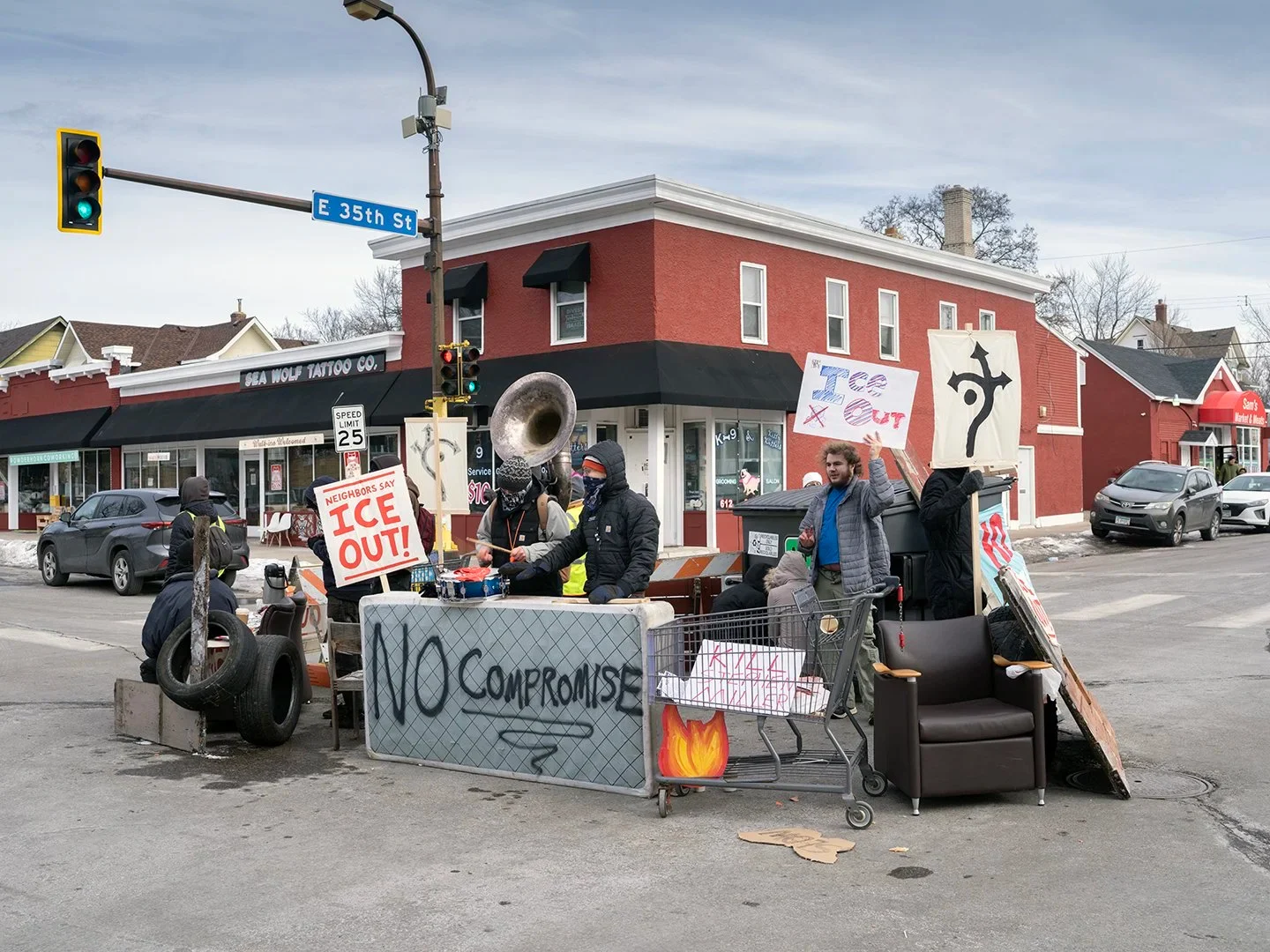
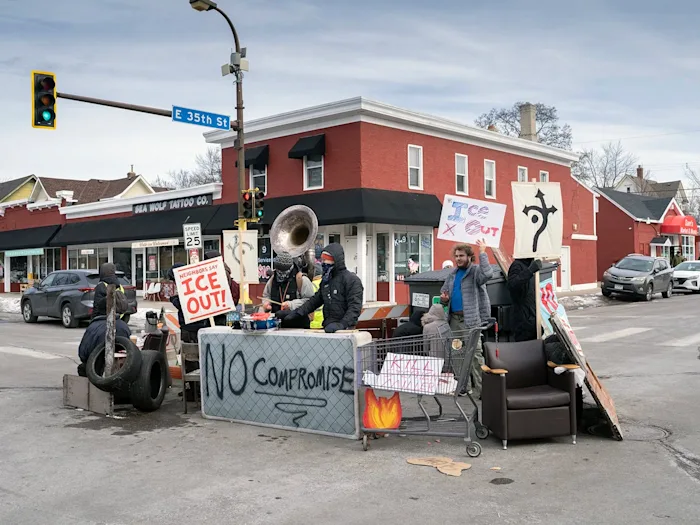
Reentering an alliance, the ruling class sought to crush the resistance before it could mature into a legitimate administrator of the city. For the RRN to have become a true dual power, it would have had to overcome at least three limits.
Limits of the rapid response network
Firstly, if the RRN was an extremely embryonic organization which could mature to supplant the police, its revolutionary potential was limited by not having an attendant popular institution to reorganize economic and political life. While this second dual power institution could have taken several forms, a missed opportunity for it to develop was the cancelled March 1 rent strike.
Tenant organizing proliferated throughout Metro Surge. Whole buildings got together for the first time and talked politically. Already-organized buildings redoubled their efforts. In January, several renters associations joined forces as a city-wide union. Together, the newly formed Twin Cities Tenants Union announced an audacious goal: 10,000 renters would withhold millions of dollars from landlords starting March 1. Unfortunately, the TCTU did not meet its commitment quota and voted against the strike.
A thorough autopsy of organizing preceding the strike vote is necessary, but beyond the scope of this essay. Still, let's not assume the outcome was inevitable. A much smaller number of strikers could have overwhelmed eviction courts, creating a buffer for those involuntarily caught in the process. Perhaps getting the ball rolling would have built enough momentum for thousands more to join by April. Of course, this is speculative. But the fact that the governor immediately pleaded with organizers to call off the strike suggests unleveraged power at the exact time economic disruption was becoming the next terrain of struggle. After ICE was forced to withdraw from the Twin Cities, the White House retributively denied Minnesota $250 million in Medicaid reimbursements. Striking renters would have squeezed the local political class from two directions.
Regardless, even if the strike occurred, revolutionaries would have had to immediately reconstitute its nature. Unions are bound by an essentially reformist relationship. They are mediating bodies, advocating specific reforms on behalf of workers to the establishment. Unions are not a dual power. While on strike, revolutionaries seeking a dual power would have had to advance the seizure of properties outright for the people living in them. There would no longer be a “demand” upon the city's old guard; the people themselves would imminently socialize their housing. A RRN on-the-rise would defend the expropriated housing from police trying to reinstate the old property relations. The two organizations of dual power would come together, and on this basis, contest the regime. This sounds a bit fantastic. But, there are moments that totally suspend common judgment, in which everything is up for grabs. Revolutions emanate from those moments, and rely on fantastic visions.
This brings us to the next limit: the whole movement, and the RRN in particular, doomed itself by orienting around the slogan "ICE OUT!"2 The slogan itself does not characterize the revolutionary potential of the movement. "ICE OUT!" is indifferent as to whether ICE left because they were forced to, or because they accomplished their mission. As a demand, it shrinks the imagination. But for the RRN, "ICE OUT!" prematurely sunset its own existence. Under such a banner there was no need to envision the RRN after the occupation. Indeed, as DHS agents withdrew from the Twin Cities, the RRN atrophied.
The RRN was always bound by a form-function relationship. Before Metro Surge, an immigrant rights nonprofit ran a centralized tip-line to report major targeted ICE operations. By December, that model was completely unviable. The decentralized, neighborhood patrol calls replaced the outdated tip-line in order to catch or prevent street level snatch-and-grabs. It was built in response to an over-saturation of agents, optimized for visual confirmation, and heavily depended on accurate countersurveillance datasets. But each of these pillars was undermined by mid-February.
Under Homan, ICE tried to be more covert. Agents shed tactical gear for civilian clothes and increased the number of women and Latino drivers. Rubber duckies, dog-mom decals, and innocuous bumper stickers sought to disguise vehicles as friendly. New shipments of cars arrived every week, and agents were caught installing fresh license plates at staging areas. Meanwhile, rental cars used in previous weeks were cycled back to Enterprise. Visitors driving "confirmed ICE" Nissans were pulled over by patrollers, leading to many awkward disputes settled by some kind of identity verification. ICE's intentional obfuscation coincided with the drawdown of agents. Thousands of agents left the state, and those that remained were harder to spot. It was becoming more common to catch a false-positive than to interrupt a raid. There was mistrust verging on paranoia. The RRN was behind the curve of the drawdown.
What did the RRN do when ICE was “out,” but not totally gone? Revolutionaries (the author included) did not provide clear direction. The movement crashed into the limit of its orienting slogan: without a clear motive, the numbers waned and the RRN disintegrated.
Finally, nothing will actually supplant the police while remaining unarmed.3 To be clear, the point is not that patrollers should have been armed; only that the RRN would be inhibited from full dual power until it was able to also contest the state's monopoly on violence with a capacity for violence of its own. Like all asymmetric conflicts, revolution will ultimately be a political victory, not a military one. Nonetheless, guns are a de facto part of any revolution, whether they fire at the enemy or establish a détente. In this regard, American revolutionaries are in a unique position. While our comrades in other countries have to smuggle arms across borders or 3D print them in the mountains, millions of Americans already own AR-15s. Those that don't can get one at Walmart.
But if the question of acquiring guns is straightforward, organizing them is a different matter altogether. After Alex Pretti was killed, an unknown group of Second Amendmentists announced an "armed march" in Minneapolis. The group denounced DHS for executing Pretti under the pretext that his lawful concealed carry posed an imminent threat to law enforcement. Within 24 hours, the march was cancelled because of enormous public suspicion. Public backlash had little to do with the guns; hardly anyone in the movement seemed to care that Pretti was armed. The controversy was that no one knew the armed group. This was particularly alarming in the context of city-wide hyper-local organizing that drew tens of thousands of people into close contact. Who were those guys? It's possible that they were honest, well-intentioned people; it's possible they were not. Regardless, when the popular movement had no established link to them, suspicion that they were malicious actors was so strong it forced them to cancel the march.
With guns, trust over their disciplined and restrained use is essential. A high degree of relational work will be as necessary as technical knowledge. If the popular movement ever reached the point of becoming armed, it would have had to emanate from within the RRN itself.
The specter of civil war
If the RRN was able to overcome these limits before being eclipsed by the drawdown, it might have been able to exacerbate jurisdictional conflicts between the state’s armed forces, to create an even more unstable position.
Throughout Metro Surge, the liberal block of the ruling class was openly fearful of this exact escalation. In January, The Guardian published the headline, "We Ran High-Level US Civil War Simulations. Minnesota Is Exactly How They Start." The article depicts armed conflict between state and federal forces in a major city as one precipitating event to civil war. Even before the article was published, Trump had already threatened to invoke the Insurrection Act. As the resistance grew, he put 1,500 winter-ready active duty soldiers on standby in Alaska. Military police at Fort Bragg were also readied for possible deployment. Tim Walz compared the situation to Fort Sumter, the first confederate shots of the Civil War (he also warned that John Brown "is certainly not where we want to go"). If Walz lamented possible John Browns, Frey held back Union soldiers. Despite an influx of calls for the Mayor to deploy MPD against ICE operations, he was unwilling to authorize it, stating "we cannot be at a place where two government entities are literally fighting one another."
The acute tension in the Twin Cities played out amidst highly irregular actions from US armed forces. Earlier in the year, Trump told military leaders to use "dangerous" American cities as "training grounds." Unlike in the 2020 uprising, when his then-Defense Secretary refused Trump's suggestion to "shoot protesters in the legs," DHS agents in Minneapolis murdered two rapid responders in broad daylight. Trump posthumously characterized both as terrorists while boasting immunity for federal agents. Senator Mark Kelly, a Navy veteran and member of the Congressional Armed Services Committee, filmed an ominous video with five colleagues reminding military officers to refuse illegal orders from the White House. The message either suggests knowledge of illegal orders, or presumes them to be likely. Regardless, it foreshadows two possibilities that are incumbent upon revolutionaries to take seriously: US military operations against its own citizens, or the armed forces refusing presidential orders.
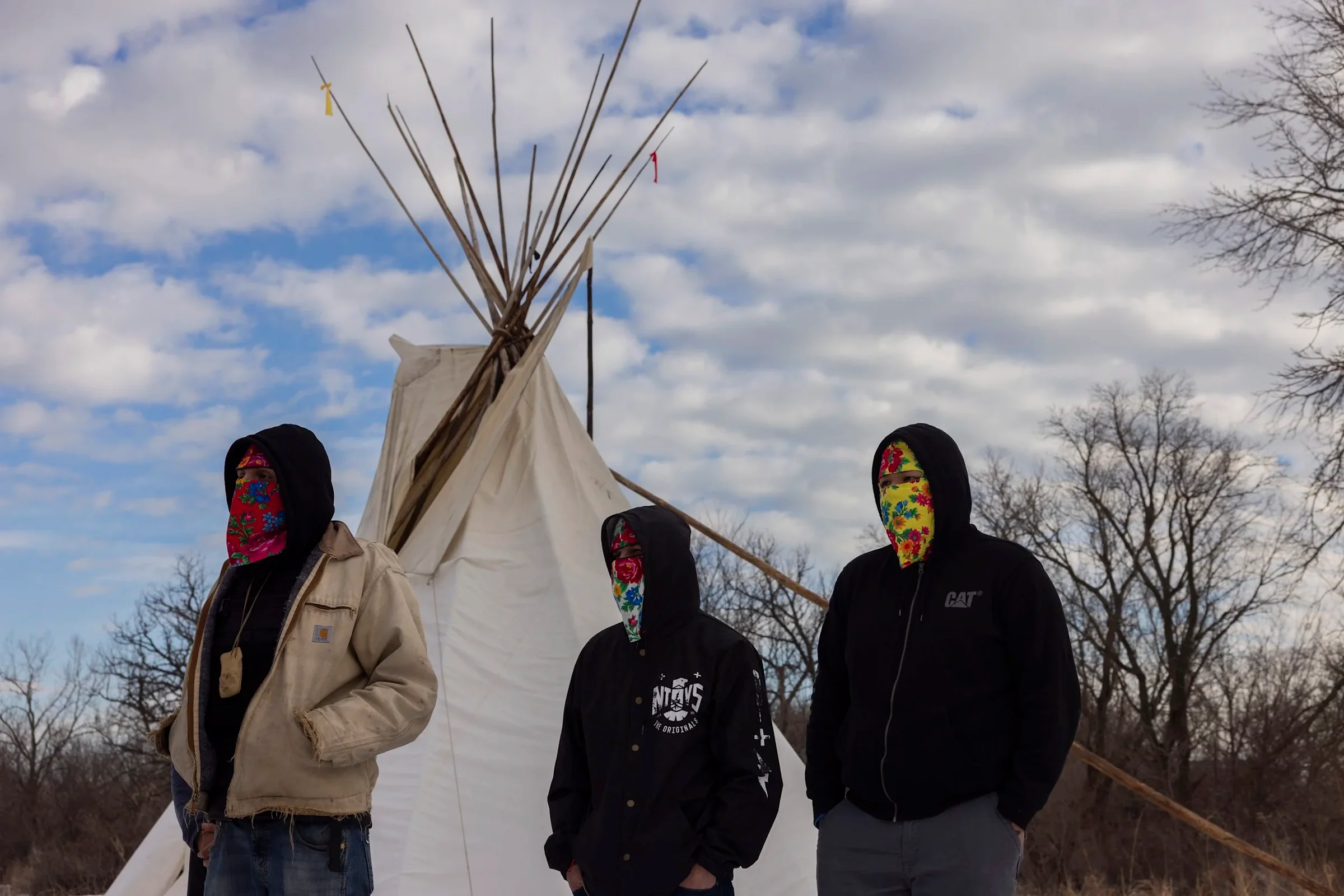
If civil war is in the headlines of major publications, in the mouths of a fighting ruling class, and on the minds of millions of people, revolutionaries should not retreat from the idea or dismiss it as hyperbole. We need to engage the debate directly, and reframe it from the perspective of a viable, populist path. Civil war makes people afraid. For many, it conjures images of vitriolic brother-on-brother violence, senseless mass death, and utter devastation. Part of our task is to transform anxiety about a civil war into conviction for a revolution. Doing so shapes our obligations. Instead of stabilizing against a conflict that may unfold anyway, we have to organize a pole within it.
Walz and Trump obviously negotiated down from this particular scenario. Popular forces were also not organized enough to bring this situation to a head. Still, while they managed to avoid their imagined worst, meaningful tensions between the ruling class persist. Revolutionaries need to strategically track them, and act.
The coming election
It's significant that the ruling class narrativizes its disunity through civil war not merely for the dramatic conflict it invokes, but because of its historical resonance with the present. Elections are the principal way that the American ruling class shares its turn to govern. In two and a half centuries, the only time that American bourgeois democracy failed to mediate elite conflict was the Civil War, in which abolitionists and striking enslaved Africans successfully turned a war for the Union into a social revolution for emancipation. For the first time since, elections may no longer be a sufficient stabilizing force for the ruling coalition. The window for revolution is opening again.
Trump has never conceded the 2020 election. In the final days of his first term, he desperately sought to hold power, convincing millions of people to doubt the integrity of US elections. He filed more than sixty lawsuits, organized fake electors, and instructed allies to forge vote tallies. As a last-ditch effort, 2,000 Trump supporters stormed the US Capitol on January 6th, 2021 to stop the certification themselves. In spite of these unprecedented attempts to maintain power, Trump failed.
A key conspiracy of 2020 election denial is that people voted illegally. For instance, Trump falsely claims to have won Minnesota in all three of his elections, "if you count the legal votes." Five years to the day of the Capitol Riot, he sent 2,000 ICE agents to the Twin Cities, making it the largest immigration enforcement operation ever. On the same day that Alex Pretti was murdered, Attorney General Pam Bondi extorted Tim Walz, stating that access to the state's voter roll would be a precondition for withdrawing federal agents. In doing so, she linked alleged Somali fraud (the pretext for Operation Metro Surge) to doubts over the integrity of Minnesota's elections.
Meanwhile, Trump demanded 48 states submit their voter rolls for federal "curing," in which the administration will strike voters it deems ineligible. The federal government has never done this before. A few dozen states have refused, and are being sued by the Department of Justice. In August, Trump posted on Truth Social that “States are merely an ‘agent’ for the Federal Government in counting and tabulating the votes. They must do what the Federal Government, as represented by the President of the United States, tells them, FOR THE GOOD OF OUR COUNTRY, to do.” In February, Trump advisor Steve Bannon suggested ICE guard polling locations for the 2026 midterm elections. Then, Trump signed an executive order establishing a federal list of eligible voters, to be maintained by DHS.
This brazen electioneering, over which DHS is an executor, distinguishes the coming election from those of 2016, 2020, and 2024. Trump is dismantling the guardrails which narrowly kept him from overturning his previous election loss. Personnel in the DOJ, FBI, and DHS who investigated Trump, prosecuted January 6 rioters, or upheld the 2020 election results have been replaced. All three dozen election specialists from the Cybersecurity and Infrastructure Security Agency were fired. The new Director of Election Security tried to help Trump overturn the 2020 results. The FBI dismantled its Public Corruption Team and raided the Fulton County, GA elections office for evidence of voter fraud. Trump pardoned January 6 defendants and is now trying to create a federal fund to compensate them. Unlike 2020, he is more prepared to hold power through a loss. Unlike 2016 and 2024, the election is losing any remaining stature as “free and fair.” Especially if Trump sought a third term, which he has repeatedly mused, it would be totally outside the bounds of order and therefore an elite outrage. Yet, the Democratic establishment has no plan; it has only a futile fidelity to the dying norms of liberalism through which it originally came to power.
If elections are no longer a vector for balancing elite conflict, can we imagine a scenario in which popular upheaval around the elections could evolve into a revolutionary situation? We ought to be able to. The recent Supreme Court gutting of the Voting Rights Act was just used to eradicate majority-Black districts across the South. Millions of Southern black voters, some of whom still wear the German Shepherd inflicted scars of the Civil Rights Movement, are outraged. It was their armed voter registration drives and mass organizing which baptized the revolutionary groups of the 1960s and 1970s that many of us look to for inspiration. In fact, from that period to the Civil War, to the first American Revolution, suffrage is a throughline of the American revolutionary tradition.
While the anti-ICE struggle has been the most combative movement of the second Trump term, the No Kings protests have been the largest. Each successive march has drawn millions of more people than the last, topping out at 8 million Americans in over 2,000 cities. Revolutionaries will need to draw these two struggles together, and organize within No Kings to turn its horizon from election integrity into an altogether new force for communism. We might even take inspiration from the original "No Kings" movement 250 years ago, which correctly asserted that when a government becomes destructive to its people, it is our duty to abolish it and organize a new one.
As a revolutionary pole in the disintegrating liberal order, what we offer to the mass movement must be more than a combative tactical repertoire. Rebellion will certainly be necessary, and we should encourage it and participate. But without revolutionary organization ready to usher in something new, "election riots" will be only the extravagant edge of protest, a more militant way to "make our voices heard." Instead, a dual power, with the active participation of hundreds of thousands, ideally millions, of people must be poised to take over where the warring elite factions fail.
Images: Patience Zalanga, Xavier Tavera Castro, and Jaida Grey Eagle.
Notes
1. As the rapid response network was not an organization, but a memetic form, its political character changed between neighborhoods. It’s true that in some areas — especially the suburbs — dispatchers did give instructions, typically to disengage or remain observers. In this way, it is essential that partisans are the ones to compose functions like dispatcher, which are highly influential on the character of interactions with agents. ↰
2. Despite its limitations, the slogan was, afterall, the one under which more than 100,000 Minnesotans organized their conspiracy. If this particular slogan was necessary for such a broad mobilization, then perhaps what was needed was the self-conscious organizing of revolutionaries to pre-empt the limit of the slogan and be ready to overcome it with a new organizing principle, much like what is suggested with the rent strike.↰
3. Of course, some rapid responders were armed. Alex Pretti is one example. But the question of revolutionary armed defense is beyond a matter of individual proclivity to carry arms and requires their organized use.↰