What Is a Repertoire?
Ian Alan Paul
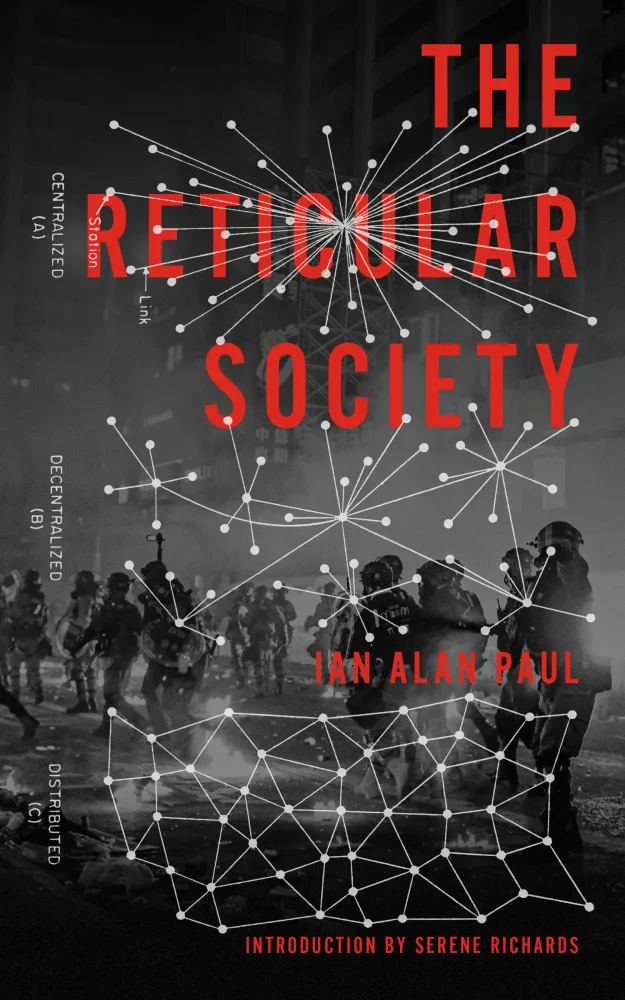
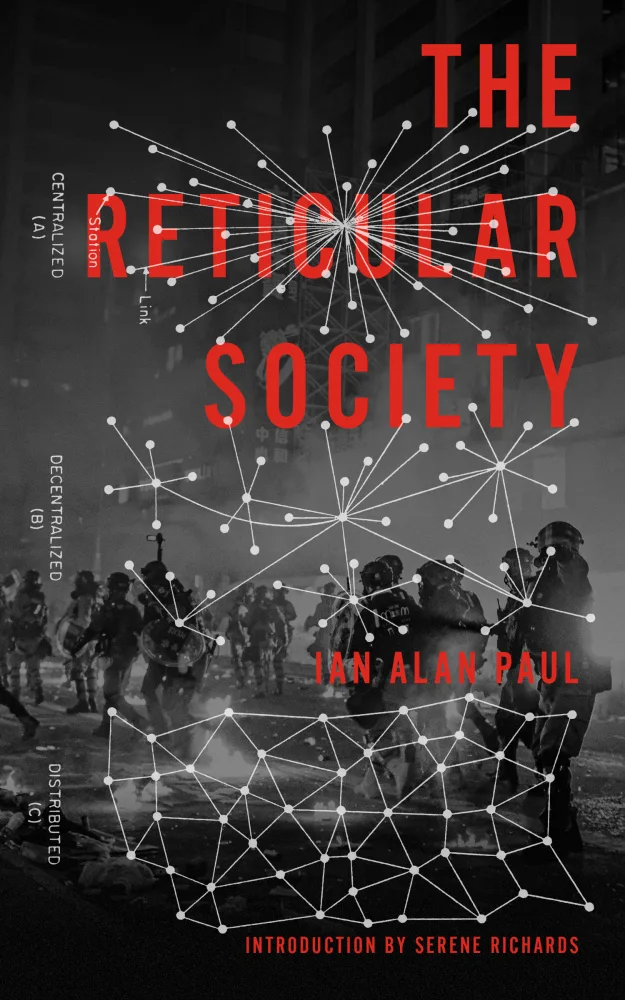
Ian Alan Paul’s The Reticular Society offers a situationist-inspired critique of how the logic of optimized computation and networked calculation has expanded and deepened the capitalist project of exploitation and domination. As Paul shows, the more that human experience becomes integrated, the more captured, isolated, and impoverished it becomes. In anticipation of its English publication in book form (French and Spanish editions are also newly out or coming soon), we’re publishing a new afterword, “What is a Repertoire?”, written especially for this edition. The Reticular Society is now available for pre-order via PM Press, and will be shipping in spring 2026.
Other languages: Français
Within the movement of history, there is an immense clamor of gestures. Hands busily place components onto circuit boards as they flow down assembly lines, and arms extend to topple the chain-link fences that surround detention camps. A finger slides across the surface of a screen, a back arches to lower a child into bed, and a tangle of bodies sprints forward and breaks through lines of police attempting to encircle a crowd on the street. At times instructed or coerced and at others conscious and free, our lives are lived as gesture upon gesture, as forms searching for their shape in the world.
Over centuries, our understanding of the gesture has narrowed to the degree that it is now seen as including only the expressive and communicative movements of the body. The gesture is in this limited and impoverished sense understood to be simply one part of a visual language, an image of movement intended only to be interpreted and read. This narrowing of the gesture’s meaning was accompanied by the historical ascendance of surveillance technologies, of representative politics, and of the spectacular economy, the historical ascendance of life understood as an image. But in the etymology of gesture we find a far more ample concept that involves all of the ways we carry ourselves in the world, all of the ways a life becomes movement as it unfolds across the dimension of time. The gesture in this broader sense concerns appearance as well as action, sensuality as well as physicality, allowing us to approach life not only as something to be perceived but also as something with force. It is on the basis of this widened understanding that we can begin to diagram how the gesture gives form to the autonomy and creativity of life, as well as how mechanisms of domination and control aspire to capture and take the gesture as their own.
Gestures are improvised and invented anew every time they are enacted, but gestures are also repetitions, calling on histories of past gestures just as they too become history. To scale a cliff for the hundredth time draws from the ninety-nine other climbs that preceded it, just as it elaborates in novel ways on them and emerges as a uniquely singular climb. In this way a gesture makes use of already existing muscles, memories, instincts, and techniques that were given form and shape by past gestures, just as it reforms and reshapes them in the very process of its enactment. In one of the final scenes of Alfonso Cuaron’s Roma, we glimpse this simultaneous invention and repetition of the gesture: After a child is rescued from the rough waves of the sea and carried to their family ashore, everyone wraps their arms around one another as they collapse together onto the sand. This embrace resembles and is a repetition of past embraces — it has a familiar intensity, duration, appearance, and form — and yet it also arises as its own novel gesture, fundamentally different from every gesture that preceded it and as unique as the time and place it unfolds within. Repertoire is the concept we have at our disposal for attending to this unique yet repetitive character of gestures, for seeing in the singularity of each gesture its multiplicity.
A repertoire exists not as a point between the past and future but rather as the passage through which they connect and coincide, through which past becomes future and future becomes past. It is in this sense that a repertoire gives shape to gestures that are in the process of being enacted and actualized, but the repertoire also has a temporality that cannot be so neatly contained within a finite and discrete present. When we say that a dancer has a repertoire that they have developed and is at their disposal, we don’t refer to a specific gesture or set of gestures so much as a gestural potential that they have trained and sharpened over time in performances and rehearsals, a reservoir of past gestures that can give shape and form to gestures in the future. Any particular dance in this sense is inseparable from this potential to dance, from the repertoire through which any gesture becomes art. As Robert Hurley makes clear, to see a dance principally as a thing and not as a potential is to fall victim to the spectacular nature of society, to grasp the world as a collection of isolated commodities, objects, and images and thus to entirely miss the unruly creativity that underlies all of existence.
Because a repertoire concerns the way the potentials of life are expressed, it also has historically come to be taken as another object to be dominated as a means of capturing, reshaping, and subordinating life’s potential. On the hypersurveilled and automated floors of Amazon distribution warehouses, people are hired to work as “pickers” and are tasked with collecting products from plastic bins and then placing them into cardboard delivery boxes. That the job is named after the gesture already reveals so much: The gesture is nothing less in this instance than the lived form that is captured by the economy and then made to appear as labor. Each picker is instructed to stand at their station facing a computer terminal that displays an image of a product, and then a vertical tower of bins is moved by a wheeled robot so that it is beside them and within arm’s reach. A projector positioned above then flashes a rectangle of white light onto the target bin, which alerts the picker of the product’s location and guides their hand toward it, and once the product is grasped it must then be scanned at the terminal and packed away. Automated vision systems verify that the assigned product is in the assigned box, and then an audible beep signals that the task has been completed. The picker then presses a button, is assigned another bin, which a robot delivers to their side, and the process begins again.
The Amazon warehouses and those who work within them function on the basis of a perpetual and comprehensive fragmentation, a process that first isolates a particular life as a worker and then isolates the various capacities and potentials of that life by breaking it down into ever more minute and elementary gestures. The lifting of an arm, the turn of a torso, and the movement of an eye are each taken to be isolated components of a process that can be quantified, fine-tuned, and rearranged as needed by algorithms designed to optimize each task. Once broken down and atomized as far as possible, a series of signals sent from machines then choreograph these fragmented gestures and build them up into a repertoire that is programmable and thus automatable, aspiring to reduce thought to an absolute minimum as the body of the worker becomes ever more synchronized with the system’s calibrated prompts and instructions. The repertoire in this context thus doesn’t reside within a life or between several lives but rather exists as code, data, and devices, subsuming and subjecting the potentials of a body to the commands and controls of networked machines. The greater the degree to which life is effectively dispossessed of its gestures and repertoires as they are captured and placed under the management of machines, the more the autonomy of life has been effectively destroyed.
Here we see the way in which the gesture is subsumed both for its physical capacity to act within and on the world — to lean, to reach, to grasp, to lift, and so on — and for its sensual existence as an image to be read by a machine and thus to be digitally captured, analyzed, and managed by networked systems. A gesture both appears and acts, and thus it can be observed and orchestrated, tracked and trained, surveilled and subsumed. Simultaneously, the very capacity to sense is taken as another component of control. Sight and hearing are no longer the means through which to experience the world so much as they are made into inputs where instructions and information can be sent. Amazon has even patented electronic bracelets that vibrate as they approach a programmed target, transforming touch itself into another feedback mechanism and further integrating life into its cybernetic loops. Life is ultimately dispossessed not only of its gestures but also its senses as they are captured and placed under the control of networked systems that aim to move bodies just as they redirect packets of data or adjust the flight path of drones.
In this most controlled of environments, everything the picker does is monitored and then modified only to be monitored and modified again in the endless cycles of networked oversight and management. Precisely how many degrees an Amazon picker must lean over to reach a bin, how quickly they must depart and return to their station during bathroom breaks, and how many microtasks they must complete every hour is thus organized online in relation to all of the other pickers laboring away nearby. Lives and their gestures are taken as discrete variables to be balanced and adjusted in relation to every other life and gesture, synthesizing the kinetic and the cybernetic so as to further subsume life, and eventually breaking bodies as the relentless acceleration and repetition of tasks erode tendons, joints, and muscles as well as any existential sense of being. This structure ultimately effectuates and sustains the reticulation of life’s gestures, capturing them within networked systems that control the order and the form within which they are enacted. One’s own gestures are reserved for some imaginary time off the clock as more and more of life is spent struggling to complete gestures that are determined by a repertoire of the enemy. The poetry of the gesture is slowly suffocated within this online economy of gestures, within these networked forms of social domination that impose their algorithmic order on the creative capacities of life.
The economization of the gesture was built on the foundational metaphysics of Western civilization, a system that found its first complete articulation in Aristotle’s writing on ethics and politics in ancient Greece. Aristotle argued that life is composed of a series of capacities: the capacity to grow, eat, move, reproduce, and think, among others. Some of these capacities are shared in common by life across different species, but for Aristotle the capacity to reason was in essence a superior capacity and was possessed exclusively by humans, setting them apart from and ultimately above all other forms of life. The good life for Aristotle thus required rationally creating order within one’s own life, but it also required rationally imposing order on those lives that lacked reason, such as animals, or had an inferior capacity to reason, such as women or slaves. A desire to impose order on oneself becomes a desire to impose order on a home, and then a city, and then a territory, and so on. The question of capacity was thus from the very beginning articulated as a question of mastery, a question of which capacities existed in a hierarchy above others and consequently a question of which lives should rule and which should be ruled. It is from this mastery that we must recover the gesture and the repertoire, and it is against this mastery that the struggle to break free must be waged.
The metaphysical system established by Aristotle ultimately introduces life not as something to be lived but rather as a set of capacities to be used, more or less efficiently, more or less rationally, more or less profitably. Here we see the deep intimacy of technique and technology in Western society, the way in which the art of technê (τέχνη) has been totally collapsed into function, operation, and instrument. The creative potentiality of life is taken as a resource to be spent and put to work, as a set of discrete actions and capacities that must be made productive, as another technology to be integrated into the machinery of the economy and the desolation it multiplies. This economization of life implicit in Aristotle’s thought thus creates the conditions within which the capacities of supposedly inferior forms of life (slaves, workers, animals, children, etc.) must be mastered so their lives do not go to waste, so their lives aren’t misused or left without use. It is here that we can see how the gesture, as a capacity, came to be exposed to the domination and rationality of the economy and thus must at any cost be made useful. An internal economy within each life must rationally put their own inferior capacities to their best use, but this economy then reappears as an economy between lives that desires to impose a rational order on life as a whole. This is nothing less than the essential diagram on which Western society was founded: a domination of one’s own capacities that is bound to a domination of the capacities of others, a metaphysics of ruling and being ruled.
While in the distribution warehouse we saw the way in which the repertoire is taken as a means of dominating the life that performs it, in other contexts there are repertoires that are given shape so that lives can better dominate and direct violence toward other lives. Nearby the Tze’elim military base in the Negev desert there is a training center built by the Israeli military that was designed to prepare soldiers for combat in Gaza. Constructed as a mock Arab town with a mosque, central square, alleys, shops, and homes, the architectural space allows for military units to rehearse a range of operations and scenarios in a simulated environment. Soldiers sprint through the streets, jump over barriers, and practice various techniques and formations, executing gestures systematically in repetition so that over time a repertoire is formed. Israeli companies such as Bagira Systems also produce virtual reality equipment and digital training environments that can be deployed in facilities such as the Negev training center, creating simulated enemies to exterminate so that the repertoire can be further given shape and sharpened through computational means. Images of life are produced so actual lives can be killed. These architectural and algorithmic technologies ultimately aim to build up repertoires in soldiers so that when they are eventually deployed in Gaza or the West Bank, they will already have at their disposal sets of instincts, techniques, actions, and reflexes designed to inflict maximum violence. Bodies take on new muscular shapes, and senses and reflexes are honed. The repertoire in this context appears not as an economic but rather as a military technology, as something that must be continuously maintained and manufactured so that when the time comes it can be rapidly deployed to destroy.
While Israel is at the forefront of developing these training programs, there are a range of such projects in the United States as well, including the Atlanta Public Safety Training Center (known as Cop City), which was constructed to train police, as well as a facility at Fort Benning designed to prepare Immigration and Customs Enforcement (ICE) agents to execute mass disappearances and deportations. The private companies that are contracted to build these training centers, such as Strategic Operations Incorporated, highlight the modular nature of the architecture in their marketing materials, claiming that the police and military will be able to train within a reconfigurable and reprogrammable space that provides the possibility of combinatorially expanding the repertoires that are rehearsed within them. Just as military war games are designed to map our various strategies given a range of initial conditions, these training centers offer a means of developing a range of repertoires that can be put to use in a range of scenarios and situations.
The systematic weaponization of the repertoire is one of the reasons police around the world can be recognized so easily, not simply because of their similar uniforms and equipment but also because they enact the same repertoire of gestures when they go on the offensive, organizing themselves into lines and snatch squads, following scripted tactics and rehearsed formations in a largely homogeneous form. In Israel and the United States and across a global network of nation-states, we thus see the simulated violence of the past build up into repertoires that are then actualized to dispense immense amounts of violence in the present and into the future. If in the Amazon warehouse the repertoire is weaponized as a means of subjugating the very same lives that are compelled to perform them, in these simulated training centers the repertoire is weaponized so that some lives are prepared to brutalize and eliminate other lives.
Counterposed to these forms of domination that take the repertoire as their material are practices that take the gesture as something radically opposed to order and constraint, as that which has the potential to liberate and spread disorder rather than dominate and impose order. Across the revolts of the twenty-first century, a wide diversity of repertoires has taken shape, which has then gone on to circulate between revolts, passing back and forth across constellations of struggles. Paradigmatic in this regard were the uprisings in Hong Kong in 2018, which culminated in an astonishingly creative process of invention and experimentation. New shape was given to repertoires that were concerned with creating multilayered lines of defense at the front of marches, rapidly assembling and dispersing in response to police deployments, dearresting people when they were grabbed by the police, and using lasers and throwing projectiles to defend space. Emerging physically on the streets in the tumult of conflict and also emerging sensually as a multiplication of images shared between friends across neighborhoods and cities and then jumping across borders, the gestures and techniques of this uprising would later reappear and take on new shape in uprisings in the United States, Lebanon, Thailand, France, Iran, and other sites of social explosion in the months and years that followed. While in the economy the appearance of the gesture as an image emerges as a means of control, in the context of uprisings a gesture’s appearance as an image takes on a different potential as it contagiously spreads to disparate places where people perceive what is unfolding elsewhere and then begin to experiment with it wherever they are. These images rapidly multiply and spread across the network form of society, just as they rapidly jump offline and crash into the streets as they struggle to find new shape and form in relation to the specificities of their context.
Spending time with one of these gestures in particular may help reveal the way in which a gesture finds a place and is developed within a repertoire. Tear gas has proven to be the weapon of choice for many police departments around the world who aspire to quell uprisings by suffocating them in clouds of toxic gas, and as a result finding ways of responding to the use of tear gas has proven to be one of the essential repertoires to be cultivated and popularized within uprisings. The first time you are exposed to tear gas, the instinct is to run, to hold one’s breath and flee in whatever direction leads most quickly away from the gas. This frantic and desperate attempt to escape most often results in a dispersion of whatever had been taking place as well as a dramatic increase in vulnerability as crowds fragment into panicked and isolated individuals who are easily brutalized and arrested. One of the first repertoires that begins to take shape in such situations thus simply involves preparing yourself so that you don’t run but rather walk and remain calm, creating time to take in your surroundings and then proceed in a different way. Such an elementary shift in gesture is enough to radically transform the situation, holding together those who have gathered, making it possible to defend and take care of one another, and thus creating further time and space for the emergence of other gestures. This switch from running and fleeing to walking and remaining calm thus functions as an action but also an image that can be perceived by those nearby, becoming relational as those who might otherwise run see people around them remain calm and thus find a way of remaining calm themselves.
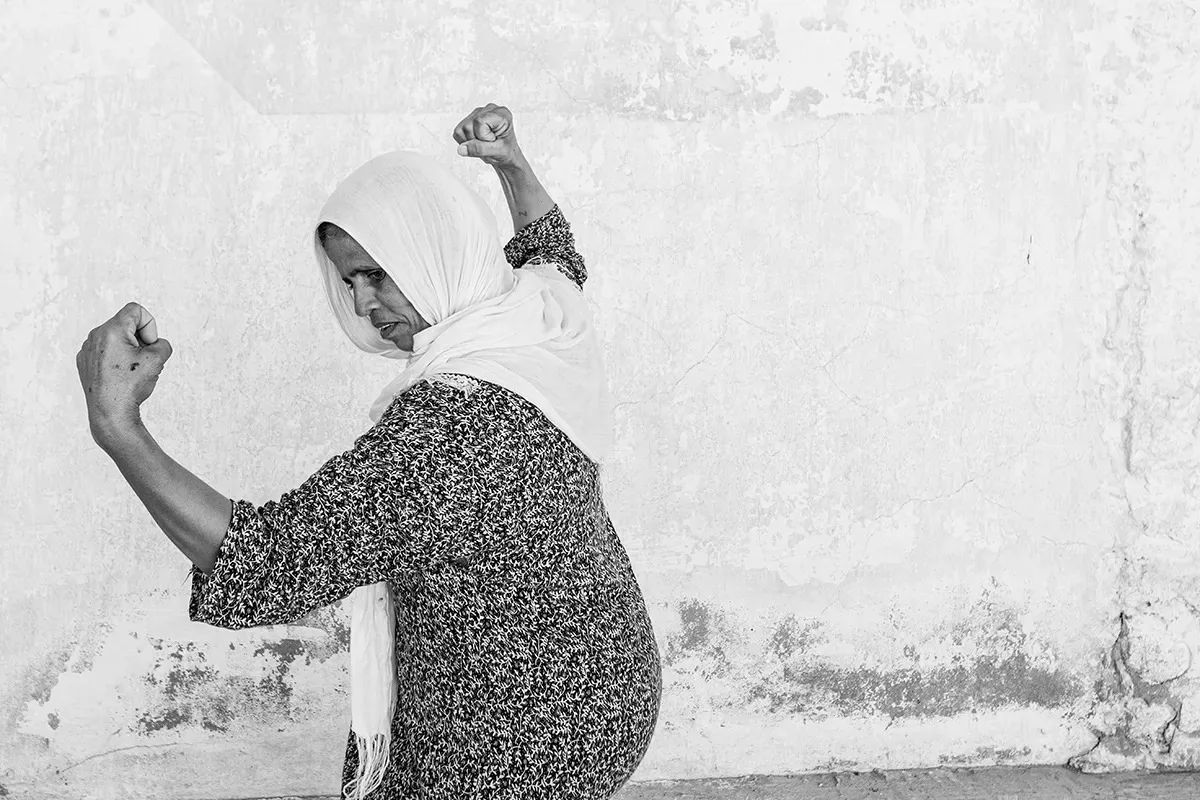
Once people have developed the repertoire of not panicking or fleeing from the gas and thus of creating time to respond within it, other repertoires then become possible and begin to take form. When tear gas canisters are fired and fall into a crowd, people have learned to throw them back toward the lines of police, a gesture that seems on the surface quite straightforward but in practice involves considerable technique and thus must be practiced and refined like any other art. As tear gas canisters get dangerously hot when they are activated, they not only must be handled with heat-resistant gloves but also must be picked up quickly and released just as fast to avoid being burned or letting the gas spread too far or too thickly. As someone who has developed this repertoire goes to grasp the canister, their whole body leans over and flexes like a bow. Their arm then quickly arcs from the floor over their head in a continuous motion, minimizing the duration the canister is held while releasing it into the air with maximum force as all of the tension that has been built up in the body is released, sending the canister flying along an elegant curve that is an extension of the curve of the body that threw it. The crowd is thus given relief from the gas, and the police must then contend with the effects of the very weapon they had deployed. This gesture of throwing back a tear gas canister takes on further shape each time it’s enacted, and thus it steadily builds up into a repertoire, not so different from the way a pirouette in ballet or a riposte in fencing is refined over time.
In Hong Kong an additional repertoire was developed to counter the use of tear gas, involving multiple people collaboratively executing gestures together in a tightly choreographed sequence. As soon as the canister hits the ground, one person covers the canister with a traffic cone while several others douse the area and pour water directly into the open top of the cone, interrupting the flow of the gas quickly and effectively. This particular repertoire has the advantage of freeing others in the crowd to pursue other gestures. Seeing that one group is capable of rapidly and artfully neutralizing the threat of tear gas allows other individuals and groups to engage in all of the other gestures of the revolt, such as dragging things into the street to block police vehicles, attending to injured people in the crowd, or spraying graffiti across the surrounding walls. To rephrase Gilles Deleuze and Baruch Spinoza, the revolt does not concern itself with what a life is so much as what a life can do, a shift that abandons any need to define or fix the gesture as a thing, as it arises instead as creativity and autonomy and thus as an immense danger to all forms of domination and control.
The physicality and sensuality of the gesture come to take on a completely distinct formal logic as it exits the economy and erupts as revolt. Actions and their appearance no longer are means of capturing and orchestrating life but instead offer a collective intensification of what life can do and be. The things that are done and are seen in an uprising provide the fuel for further experimentation and improvisation, for an uncontrolled explosion of gestures in revolt that is oriented principally toward the multiplication of life’s potentials. Uprisings are in this sense nothing less than an insurrectionary laboratory of the gesture, allowing forms to become sharpened and elaborated as a consequence of repertoires building on repertoires, and of repertoires clashing against repertoires. The shape of life finds its contours among many lives, just as everyone’s freedom is the necessary condition of any one life living freely.
What is clear in retrospect in the case of the uprisings in Hong Kong is that even this creative explosion of new gestures and the militant refinement of repertoires was not enough to defeat the militarized police forces of the Chinese state that had invaded the city. The revolt was in the end brutally repressed, and then the pandemic largely erased its memory from the world’s imagination. However, the uprisings of Hong Kong (like all uprisings before and after) still have an immense amount to teach us. One lesson we can learn involves the need to create and defend an open space for the experimentation with and evolution of repertoires, to not allow uprisings to split over some ideal form of action but rather to see the ways in which diverse gestures can build on one another not in a strict and imposed harmony but in a creative and cascading cacophony. Deciding exactly what kinds of repertoires will be allowed within an uprising in advance and then policing uprisings so that they follow the script is a recipe for remaining irrelevant and learning absolutely nothing. The presence of various authoritarian groups within uprisings — whether appearing in the form of liberal peace police who demand everyone endlessly march in circles or party activists intent to control uprisings so they can be the ones to ultimately lead and represent them — is thus nothing more than another constraint that ultimately must be broken by the unruly gestures that are always already circulating and taking shape in these situations.
Another lesson involves the need to spread and multiply the uprising beyond any isolated context, allowing gestures to multiply and mutate into a form that may prove capable of finally overwhelming domination on a global scale. While the form of an uprising in a suburb, town, or metropolis will greatly vary, as will the gestures deployed within them — what arises as a valuable repertoire in Cairo will be quite different than what is needed from a repertoire in Los Angeles, the Susa Valley, or Jenin — it is clear that gestures and repertoires must nonetheless find ways of circulating between these diverse contexts so that they can be adapted and translated into new forms as needed. This planetary transmission of and experimentation with repertoires has become necessary principally because the police and military forces that they oppose also circulate repertoires between them across countries and continents. It is in this sense that the supposed division between “domestic repression” and “foreign operations” is simply a mirage that masks the never-ending elaboration and diffusion of all forms of state violence, emerging as global forms of domination that must be confronted by global forms of revolt. Just as Israeli military forces train riot police in the United States, so too must uprisings find ways of circulating repertoires, gestures, techniques, forms, capacities, and knowledge between them.
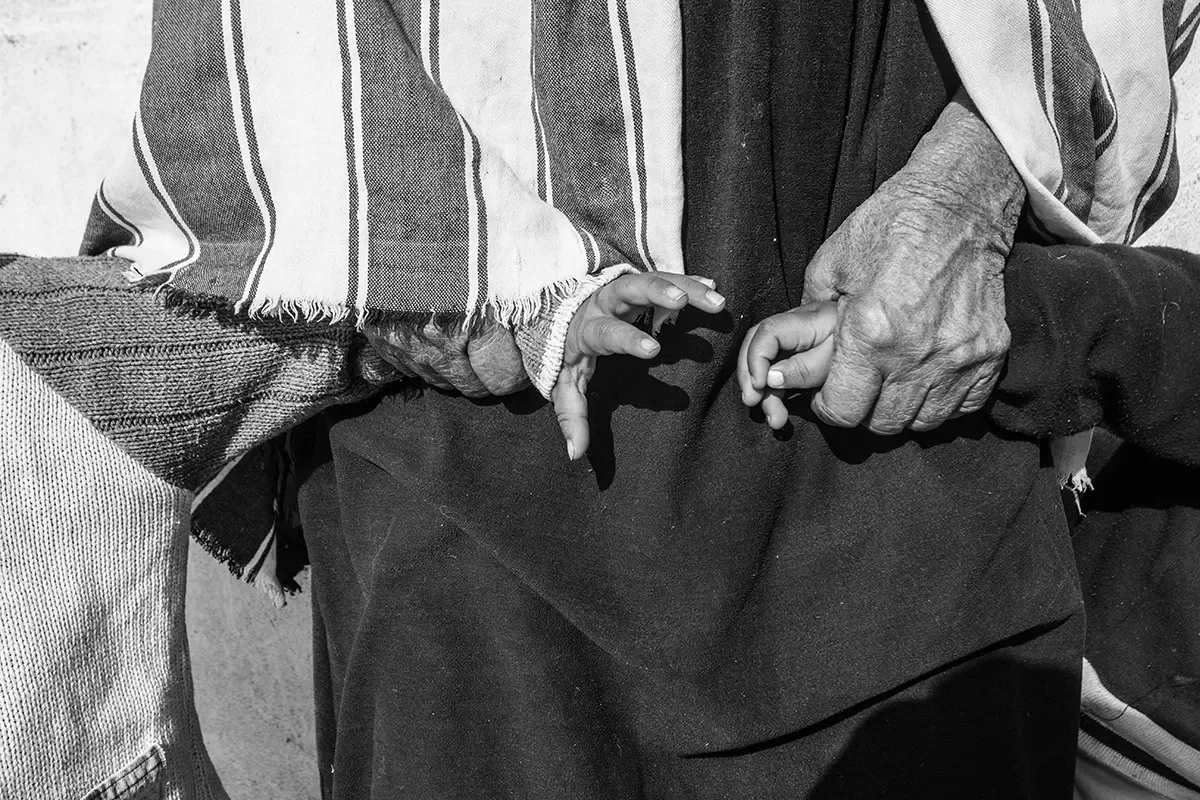
Those who took part in the uprisings in Hong Kong compiled what they had learned on the streets into electronic pamphlets that could be read by people everywhere, thus spreading and multiplying repertoires that involved how to remain fluid in the streets, how to dismantle surveillance equipment, how to hold space, how to remedy the effects of chemical weapons, and many others. This practice of developing but also sharing what unfolds in an uprising must be consciously generalized in the years to come, with each repertoire being understood both as action and as image, as practice and as theory, as a repertoire that unfolds on the streets but also as a repertoire that spreads as a concept. It is only through a collective multiplication and refining of repertoires that uprisings can emerge not as a form of disorder that remains fleeting and isolated but as a form of disorder whose scale and force is world historical.
Capitalism’s fragmentation and subordination of gestures is a profound assault on life itself, an uncompromising war waged against life and all the creative forces that are involved in living. A fundamental dimension of our autonomy thus can be found in the ways we approach our life as its own singular gesture, as a potential continuously unfolding over our lifetimes that is entwined with the potentiality of many other lives. The total atomization of network society that breaks apart this gesture of our lives into ever smaller units subjected to oversight and control results in nothing less than a total disintegration and degradation of what it means to live. Life crumbles into scattered capacities to be measured, calculated, and spent, capacities that are then ordered and organized in ways that are essentially hostile to life and that make it less and less possible to contemplate or value life itself. What is a repertoire? A repertoire is that which capitalism and network society have historically managed to capture and domesticate, to subsume and economize, to train and tame. What is a repertoire? A repertoire is that which must be taken back as a means of living the autonomy and anarchy that is inherent in life, of defending and intensifying all of what in life remains creative, wild, and free.
The Reticular Society is available for pre-order via PM Press now.
Images: Zied Ben Romdhane