On Tyrannicide: Five Lessons for Luigi’s Critics
December 4 Legal Committee
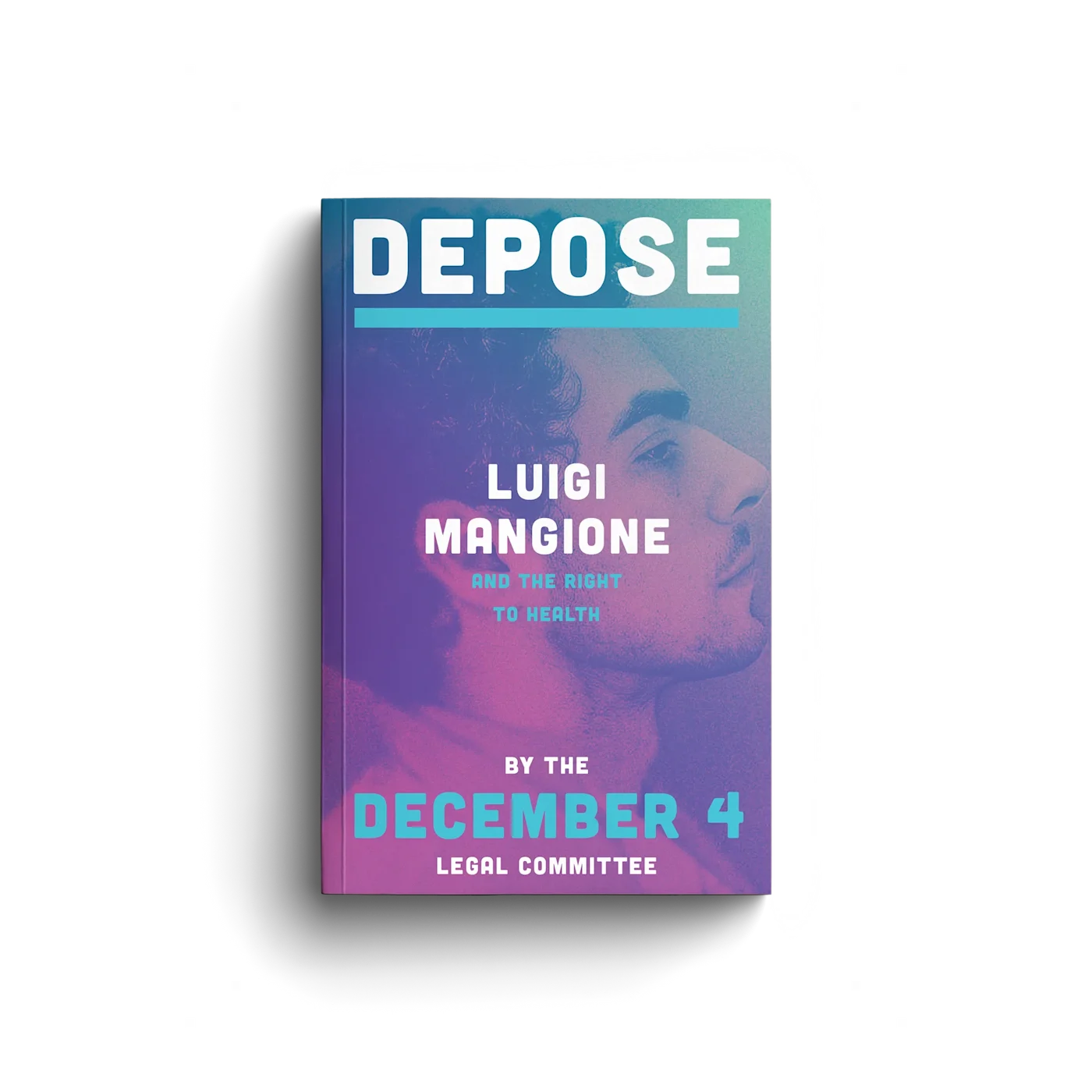
In this excerpt from their forthcoming book, the organizers of Luigi Mangione's legal fund situate the Manhattan CEO shooting within the classical tradition of political tyrannicide, drawing out five lessons for our present.
Depose: Luigi Mangione and the Right to Health is available for pre-sale at illwilleditions.com.
Piers Morgan: To those who think this shooter is a hero because he did it, because he said this healthcare executive is presiding over a healthcare system which kills thousands of Americans by denying them coverage. What would you say to them?
Peter Thiel: [edited for clarity] I don't know what to say? I still think you should try to make an argument. There may be things wrong with our health care system, but you have to make an argument and you have to try to find a way to convince people and change it by that, and this is not going to work. I don't know. All sorts of things one could say about it. But I think the motives feel… I don’t want to go into all the particulars here but I don’t think there’s anything heroic about him.1
“What Murder?”
If we could distill the message of over 25,000 comments on Luigi’s legal fund page into a simple argument, it would go like this:
It is morally wrong to murder; To profit from depriving others of life-saving care is morally equivalent to murdering them; When one kills someone who is murdering others, it is not “murder” but an act of heroism. Therefore: while it is morally wrong to murder, to kill someone who profits from withholding life-saving care is an act of heroism.
The most surprising thing to us has been how widely shared this argument is.
Americans today often appear to live in irreconcilable political bubbles, each with its own facts, histories, and ideas of what life is about. But the December 4, 2024 killing of United Healthcare CEO Brian Thompson seemed to call a Christmas truce in the culture war. The usual fighting ceased on the usual fronts. People seemed to drop their weapons and behold the possibility of a struggle framed not as Left vs Right, but as Down vs Up.
This shift eased the tensions across many strained relationships. We heard reports from family holidays across America, describing woke Zoomers and MAGA uncles alike joking on their newly discovered common ground: whatever the law or the media says, in this house, Luigi Mangione is a hero.
Over the last year, we have asked ourselves what it would take to hold this breach in the divide open and invite everyone to build upon the common ground it exposed. Depose: Luigi Mangione and the Right to Health is our extended answer. We’ve challenged ourselves to step outside of our own bubbles and to make an argument we hope can be understood and discussed across America’s contemporary political chasms.
Into the breach
We have not written a book that fawns over the real human being named Luigi Mangione. We don’t know if he did what they say he did, and we’re not here to speculate about how his personal biography may or may not make sense of it all.
For us, what matters is millions of people around the world believe he did it — and they love him for it.
Hypothetically, let’s say these supporters are correct. Let’s say a young man from a wealthy background gave up his future and his fortune to strike a blow against an industry that parasitically extracts profits from the most vulnerable moments of people’s lives. Suppose further that his aim was not just to subtract one greedy CEO from the world, but for this act to spark a movement to transform the health care system. If all that was the plan…then what? What would it take for his action to become successful? How could the rest of us make him into the revolutionary he set out to become?
Focusing on this question and the surprising range of his support has led us to adopt, as a kind of thought experiment, a view that sees the struggle for universal health care as the central struggle in American life, one with the potential to remake our political landscape. With this in mind, our book is organized around the following questions and paths of investigation:
If the right to universal health care has been adopted by so many other countries, what forces have worked to delay this right for Americans? This question brought us to examine the history of the struggle for universal health care. Drawing from this history, we develop a practical understanding of the institutions that have maintained health care as a for-profit industry and the various debates that cloud this understanding.
How is it that those who embrace the American tradition of inalienable rights to “life, liberty, and the pursuit of happiness” can deny the human right to health care? The Declaration of Independence asserted that the duty of government was to protect these fundamental rights, and that any government that does not is a tyranny. But what could it mean to protect “life, liberty, and the pursuit of happiness” apart from providing health care? Something seems to have distorted our basic common sense around these inalienable rights. Clarifying this distortion will make it easier to perceive the way tyranny functions today.
Finally, how might a people who decided to assert their right to health care organize to depose a tyranny that denies it? Our starting premise here is that, under the current conditions, it is politically unrealistic to have any faith that existing political institutions will recognize this right. But we also know that it is possible, through mass direct action, for everyday people to transform political reality. If there is broad agreement across the political spectrum that health care is a human right, then we need a movement that asserts that right against the political and legal institutions that have for so long denied it.
Our aim, in short, has been to re-examine the core values of America from the common ground we glimpsed in the response to the killing of UnitedHealthcare CEO Brian Thompson. Then, from there, to point a path toward a new political landscape.
Defend institutions?
We don’t want to pretend that support for Luigi is universal, of course. There are thoughtful and sincere people who push back against supporters and caution against embracing an alleged murderer in the name of pursuing a better world. To do so, they argue, is to further degrade democratic institutions and the rule of law, which will ultimately make achieving the human right to health care in America even more difficult.


In his popular book, On Tyranny: Twenty Lessons From the Twentieth Century, Timothy Snyder argues something very similar, counseling readers to “defend institutions” as a way of resisting tyrannical government. While we’re unsure of his stance on Luigi, Snyder’s argument captures the concern of those who criticize Luigi supporters: “Institutions do not protect themselves. They fall one after the other unless each is defended from the beginning. So choose an institution you care about — a court, a newspaper, a law, a labor union — and take its side.”2
That one must defend existing institutions from tyranny is rooted in the assumption that they are, currently, democratic. But what does one do when tyranny has arrived? What does one do when once-democratic institutions have become extensions of tyrannical power? What if they were never democratic to begin with?
In the course of our research, we stumbled upon a concept that we think offers a few more lessons on tyranny, and which has helped us to make sense of the public response to Luigi.
To put it plainly: while the prosecution accuses Luigi Mangione of murder in the second degree, large portions of the American people interpret this as an act of tyrannicide — of killing a tyrant.
The history of tyrannicide is instructive for anyone interested in the question of what it means to defend, not specific institutions, but the more fundamental principle that people are usually invoking when they use the word “democracy.” Below we have assembled five lessons on tyrannicide for reflection and discussion, and which serve as points of departure for the larger project undertaken in our book.
1. Tyrannicide is an act of self-sacrifice for the public good.
While political assassinations usually serve to benefit the assassin or a rival political leader, tyrannicides have long been distinguished from these:
Since classical antiquity, it has been a well-established practice to celebrate or commemorate tyrannicides as selfless deeds … undertaken by private men pro bono publico [for the public good]. Hence tyrannicides (but never common assassins) were revered and honored as supreme patriots … Furthermore, whereas the self-serving act of the assassin was condemned, the self-abnegating deed of the tyrannicide was applauded as one of exemplary civic virtue.”3
Was the killing of the United Healthcare CEO a selfless and therefore heroic deed undertaken for the public good?
Many are inclined to assume that selfish motives lurk behind every act, if only we dig deeply enough. However, when we consider the person accused of this murder, such cynics have their work cut out for them: a high-school valedictorian, Ivy League graduate, and computer engineer who stood to inherit millions from his grandmother, provided only he is never charged with a violent crime. This act would therefore have been undertaken at great personal cost. Moreover, since he was never a customer of UnitedHealthcare, the motive of icy revenge seems likewise off the table. By all accounts, Luigi appears to be a bright, friendly, and, yes, devastatingly attractive young man with his whole life ahead of him.
Perhaps this is why those who seek to diminish his widespread support have sought to pathologize him (and the rest of us), accusing us of being sick or twisted in some way. If you assume all human action is motivated by desire for private gain, then the idea that one would kill in an act of self-sacrifice seems incomprehensible. It is as if it were not just an attack on a CEO, but on the whole theory of self-interested human nature embraced and propagated by CEOs (and economists). That a young man of strong moral conviction and intelligence would, on his own, undertake an act of killing for others breaks not just the laws of the courts, but what these cynics consider to be the laws of nature.
But historically, such selflessness is exactly what was meant by a “tyrannicide.” For this, killers of tyrants were showered with praise for having risked everything in defense of the people.
2. A tyrant is beyond the reach of the law, so the law is of no use in stopping one.
The left and right both claim to be opposed to tyranny, and both claim the other side is pursuing or enacting it. So is tyranny just in the eye of the beholder? If so, to call a killing a “tyrannicide” would not be genuine, but just one more propaganda move in the battle of perceptions.
We will have more to say about the meaning of tyranny in the book, but here we want to emphasize that it is not just a matter of perspective.
Snyder’s On Tyranny offers a first pass at an objective definition: “the usurpation of power by a single individual or group, or the circumvention of law by rulers for their own benefit.”4


While Snyder does not mention tyrannicide, John Stuart Mill does. In On Liberty he writes:
[T]he act of a private citizen in striking down a criminal, who, by raising himself above the law, has placed himself beyond the reach of legal punishment or control, has been accounted by whole nations, and by some of the best and wisest of men, not a crime, but an act of exalted virtue….5
The essence of tyranny lies in this ability of a person or group to wield power over the people in such a manner that they are outside the reach of legal consequence — in effect, to have weaponized the law as a tool for their own gain. It follows that tyrannicide is the act of killing such a person because they are a tyrant.
It is clear, then, that in a situation of tyranny, to appeal to the existing law makes no sense. Resistance to tyranny, up to and including tyrannicide, occurs on the basis of an appeal to rights that exist prior to and outside of the current political order. These rights are founded in a moral — or even divine — authority.
Perhaps this is why “Saint Luigi” was immediately beatified among the people.
Interlude: conversation with a skeptic
Skeptic: Ok, I see the game here. You all think killing rich people is cool.
D4: We understand your suspicion. But to be entirely honest, we do not think killing people, rich or otherwise, is cool. We’ve talked a lot about the conflicting feelings we had, and still have, about the killing of Brian Thompson. He was a real human being, with people who loved him and who, we assume, he also loved and cared for. That matters to us — as do the lives and loved ones of all the people affected by his decisions as CEO of a company that profited from denying them access to care. We are trying to take this dilemma seriously.
Skeptic: Maybe you’re being sincere, maybe not. But this all feels like a rationalization. In pointing back to Ancient Greece, you are stretching really far for a way to justify a conclusion you already hold.
D4: We went looking for a political precedent to help make sense of the response we saw among people — and which we also felt in ourselves. Many commentators seemed unwilling to even attempt to understand this response. So to put this event within the history of tyrannicide is an attempt to explain it in terms of a concept that was common throughout history, but for some reason has faded from use.
Skeptic: But he doesn’t even fit the definition of a tyrant that you’ve given. Brian Thompson wasn’t a politician who had weaponized the law for his own power! He was a CEO, a business leader playing a game that he himself did not create. Maybe you don’t like that game, but you can’t claim he was personally responsible for it. So the analogy with classical tyrannicide is clearly mistaken. If you are unhappy with the current laws around health care in the US, you can vote for politicians who will change them.
D4: The current US laws around health care have been shaped, in no small part, by the power of the health insurance lobby. This industry lobby has the power to make or break the career of any politician. It sets the boundaries of what is considered “politically realistic” regarding health care and is therefore, like a tyrant, “beyond the reach of legal punishment or control.”
Skeptic: Now you’re not talking about a person named Brian Thompson, but an industry. An industry cannot be a tyrant! And it is ridiculous to hold an individual responsible for the actions of an industry!
D4: We believe in personal responsibility: “industries” don’t make decisions, people do. Brian Thompson was personally responsible for his leadership of UnitedHealthcare, and he was rewarded for those decisions with millions of dollars. He may not be legally responsible for the effects of those decisions on people's lives and livelihoods, but again: the industry has helped shape those laws. He was, however, morally responsible for them.
Skeptic: I think the word you are looking for is not “tyrant,” but “oligarch” or “plutocrat.” Thompson was a wealthy man at the helm of a large corporation that, I’ll grant, wields too much political power over its own industry. But “tyranny” refers to a weaponization of the law by one person. Oligarchy is the rule of the few and plutocracy is the rule of the wealthy.
D4: So it was an oligarchicide? Plutocraticide? If you insist. But…
3. Tyranny is oligarchy on the offensive.
It is true that a distinction is usually made between oligarchy and tyranny, where the former refers to a small group in power and the latter refers to the concentration of power in the hands of one individual who holds absolute, personal control.6
In theory, sure. But the distinction is too sharp to reflect political reality and as a result, it is historically just plain wrong.7 Even single tyrants wielding personal charismatic power never achieve this status alone. There are always wealthy former or would-be oligarchs who support the rule of a tyrant, just as there are always networks of patronage that sustain and grow the tyrant’s power.
It is more accurate to see tyranny and oligarchy as different phases of a single dynamic: tyranny attacks democratic institutions to create oligarchy; once this attack has succeeded, the overt tyranny can fade into the background of a stabilized oligarchy. When this stability is threatened by the poor and excluded, oligarchs launch another tyrannical campaign to regain control.8
Let’s suppose that the US health care industry is an oligarchic racket by which corporations pillage us and torment us with bureaucracy in the most vulnerable moments of our lives. If that were a fair description, then UnitedHealthcare — which, under Brian Thompson’s leadership, had its highest rate of claim denials and the largest market cap in the company’s history — could fairly be perceived as engaged in a tyrannical offensive on behalf of this oligarchy. Thompson’s success as a CEO would, in this scenario, result from his setting a new standard of cruelty to generate profits for the wider industry. If he succeeded in this tyrannical offensive, other oligarchs would follow suit.
4. Defending institutions is not enough to defend the principle of democracy — that’s why the Ancient Greeks made tyrannicide laws.
While some homicides are legally justifiable in self-defense or in an effort to stop an imminent threat to the lives of others, nowhere in US law is a “tyrant” defined as one who can or should be killed on account of their tyranny. The curious thing is that, way back in what is usually seen as the first experiment in democracy9, such laws did exist. The Decree of Demophantos required all Athenian citizens to swear the following:
I shall kill, by word and deed, by vote and by my own hand, if I can, anyone who overthrows the democracy at Athens, and anyone who, when the democracy has been overthrown, holds any office thereafter, and anyone who aims to rule tyrannically or helps to set up the tyrant. And if anyone else kills him, I shall consider that man to be pure in the sight of both gods and spirits, because he has killed an enemy of the Athenians…10
As far as we know, there is no such oath taken by Americans; and yet Mangione has been celebrated as “pure in the sight of both gods and spirits” — or whatever the 21st century equivalent of that is. It is as if, on December 4, 2024, a deeper logic of democracy made a leap across time and context.


A law mandating tyrant-killing is a strange kind of law. If tyrants impose laws that benefit them and their oligarchic backers, then a law commanding the people to kill any tyrant (or aspiring tyrant) is a law commanding the people to break the law. This was, it seems, exactly the point of ancient tyrannicide laws:
The fundamental lesson that the Athenian pro-democrats learned from their experience in the coup of the Four Hundred11 is that the survival of their democracy ultimately depended on whether or not they could mobilize en masse even if their democracy was overthrown. It is not enough, that is, simply to have institutions that help individuals prevent a coup: people can be manipulated, and those institutions can thus fail…12
Since the law and institutional procedure can always be manipulated by organized oligarchs waging a tyrannical offensive, upholding the principle of democracy required the assertion of collective strength after democratic institutions had fallen or been captured. The oath mandating tyrannicide was one piece of building this collective strength. In a time when institutions were the weapons of the rich and the people were isolated, confused, suspicious, and weakened, Athenians learned through experience that a tyrannicide could reveal the common ground to galvanize a movement against the oligarchy.
5. A tyrannicide is not enough to depose a system of tyranny; for that, mass movements are needed.
As political-technological innovation, tyrannicide laws were remarkably effective. After the Decree of Demophantos, at least six other democratic city-states adopted tyrannicide laws of their own as a way of giving the principle of democracy a fighting chance against oligarchic coups. They demonstrated to would-be tyrants that it was not enough for them to seize power through the institutions. The oaths created a publicly known, baseline expectation among the people that anyone doing so would face a population whose defense of democratic principles was not confined to defending institutions or following procedure.13 These strange laws commanding the breaking of the law were not based on any illusion that killing one tyrant was enough to liberate the people. Rather, they were aimed at increasing the chances that someone would act in a way that could signal the willingness for further action.
The political success of any particular tyrannicide is found not simply in whether a tyrant is killed. Rather, its success is found in whether it, first, reveals a common ground among the people who are isolated, confused, suspicious, and weakened by the oligarchs; and second, whether from this common ground a mass movement emerges that overturns the system that had enabled the late tyrant.
After the tyrannicide, the mass movement (or, about this book).
This book is not an argument for the multiplication of tyrannicides. We think — we hope — that one was enough.
Instead, we treat Luigi’s alleged action in the same way that classical tyrannicides were treated: as a signal toward the need for a movement to transform health care in the United States, in a context where institutions once considered democratic have become weapons wielded against the people.
Our focus is on health care because we believe it forms a common ground with the power to break us out of the current political silos and, in doing so, stimulate the collective intelligence of the American people.
But it forms this common ground for a reason. Health care takes us to the core of our lives. It brings us face to face with both our own individual existence as well as our dependence on others. Experiences of manipulation, exploitation, tediousness, and powerlessness within this sphere inject humiliation into the most vulnerable moments in our lives: when we are facing illness, suffering, and death of ourselves and our loved ones. The result is a visceral experience of confronting, as a living and feeling human being, a system that is indifferent to life. For a heartening number of people, this feeling, and our ability to empathize with others undergoing it, is deeper than political affiliation. Such people form the potential base for a movement that could actually assert the right to health care. This book is an invitation to do just that. It is divided into three parts:
Delay outlines the forces by which the creation of a universal, single-payer healthcare system in the US has been put off for over a century. This is less a history of the struggle for universal healthcare and more a diagnosis of the institutions that have blocked it. These include not only the obvious culprits of the insurance industry lobby and both political parties, but also the American Medical Association and, to our surprise, many worker’s unions. We show how for more than a century these institutions have led to an ever more lucrative market in health rather than a health care system — and why Luigi’s alleged killing of a healthcare CEO was perceived, within this context, as a kind of miracle.
Deny examines the question of health through the lens of the inalienable rights asserted in the Declaration of Independence. It is only once we have a shared understanding of what we deserve, as human beings, that we can really say what is and is not a tyrannical overreach of government power. More than an argument for healthcare as a human right, the care for health is the fundamental human right — the right which conditions all others.
Finally, Depose begins by urging us all to accept that a right to healthcare is indeed “politically unrealistic” under current oligarchic conditions. From there we develop a strategy for transforming that political reality through the collective assertion of the right to health. Drawing on the history of labor and civil rights movements, we propose a strategic shift in the struggle for universal right to health care: from protest aimed at political leaders to direct action aimed at creating and securing it.
Whether or not Luigi Mangione killed Brian Thompson on December 4, 2024, the popular response accords with that historically reserved for tyrannicides. The manhunt, the media frenzy, the darling suspect and his consistently dignified demeanor in the year since — all of this has entered into the deep currents of folklore that nourish the idea of human freedom from one generation to the next. But the great risk is that this story remains just a folk tale, and that, whatever the fate of the real human being currently locked in a Brooklyn detention center, the hero called “Luigi” becomes nothing more than an edgy true-crime character and a model for AI advertisements.
There is a possible future where Luigi Mangione and the events of December 4, 2025 become just one more episode in an ongoing docu-drama series of human misery. In this future, oligarchs keep churning out new boots with which to press down on human faces — now with screens in the soles and chatbot therapy for the ever-intrusive thought that things could be otherwise.
But there is another future, one in which this young man — or the myth surrounding him — is vindicated by history like the tyrannicides of old. In this future, December 4 will be remembered as the day of a decisive act that began a movement to repair the health, intelligence, and lived experience of the people in America.
Cover image: "Untitled" (2025), by Sam McKinniss. All images courtesy the artist.
Depose: Luigi Mangione and the Right to Health is available for pre-sale at illwilleditions.com.
Notes
1. Jacob Bryant, “Peter Thiel Stutters When Asked What to Say to Defenders of United HealthCare CEO Killer,” MSN, December 2024. Online here.↰
2. Timothy Snyder, On Tyranny: Twenty Lessons from the Twentieth Century, Tim Duggan Books, 2017, 22.↰
3. David George, “Distinguishing Classical Tyrannicide from Modern Terrorism,” The Review of Politics, vol. 50, no. 2 (Spring 1988), 391.↰
4. Snyder, On Tyranny, 9-10.↰
5. John Stuart Mill, On Liberty, Chapter 1, fn. 6. Online here. Italics added.↰
6. For the typical firm distinction between tyranny and oligarchy, see, for instance, here.↰
7. The tyrannical threats to Athenian democracy, for example, came not from single individuals but from multiple tyrants (“the 30 tyrants,” “the coup of the 400,” etc.)↰
8. There are other theories of tyranny, including ideas of demogogic-democratic tyranny (Plato), “tyranny of the majority” (Mill), “dictatorship of the proletariat” (Marx), etc. We are here naming a specific dynamic between tyranny and oligarchy, or the rule of the wealthy few. While we do not have space to address other theories in this essay, we do examine one prominent and starkly contrasting view in Part II, “Deny,” namely, that of Ben Shapiro. During the summer of 2020, Shapiro argued that “the essence of tyranny” was on display — not in the police murder of George Floyd, but in the rebellions that followed across the country. Such a statement is very difficult to reconcile with the American traditions Shapiro claims to uphold.↰
9. There are many criticisms of the idea that Ancient Athens was the first democracy, despite its being the source of the term. Athenians practiced a “direct democracy” — that is, they did not elect representatives of the people. Representative government by election was considered an oligarchic practice, so democracy meant massive assemblies in which all male citizens were able to vote and speak. Outside of military matters, government roles were filled by sortition — essentially, drawing straws for people to serve temporary positions of leadership. When the term democracy was first resurrected in the 1643 constitution of the government of Rhode Island, it also did not signify law-making by “representatives,” but the notion that laws were to be made by “the power of the body of Freemen orderly assembled…” Election was reserved for official duties to carry out those laws. This was also its meaning when James Madison, writing under the pseudonym “Publius,” polemicized against democracy in the Federalist Papers (No. 10, in particular) in an effort to convince American revolutionaries of the need for a stronger central government. Of course, in Ancient Athens and Colonial Rhode Island alike, the principle of equal participation in government decisions was itself limited to men and to an idea of citizenship defined by place of birth or by race. At the same time, there are others who use the term democracy to name practices of community and political organization that stretch far outside what we consider “the Western tradition.” To pick one example, the Haudenosaunee Confederacy is sometimes referred to as a democracy, but one in which political decisions were not exclusive to men and inclusion was not premised upon racial identity. While the Haudenosaunee constitution (The Great Law of Peace), was an often overlooked influence on the US Constitution’s separation of powers, these features of their political organization were left aside. Should the Greek word be used so expansively? Some say yes, some say no. We speak here of democracy in order to invoke not a particular set of electoral institutions but the basic principle that decisions should involve those affected by them. However partially realized this ideal was in Ancient Athens, we use it here because we expect it is the most common reference point for historical experiments in democracy for our readers. It should be clear — but we can’t make it clear enough! — that when we write about “democracy” or “democrats” we emphatically do not mean the American Democratic Party.↰
10. David A. Teegarten, Death to Tyrants!: Ancient Greek Democracy and the Struggle Against Tyranny, Princeton University Press, 2014, 31. The rest of the oath reads: “… and I will sell all the property of the dead man and give half to the killer and not keep any back. And if anyone dies while killing or attempting to kill any such man, I shall care both for him and for his children… And all oaths that have been sworn against the people of Athens, at Athens or on campaigns or anywhere else, I declare null and void.”↰
11. An oligarchic coup in 411 BCE that concentrated governing authority to a group of 400 men. ↰
12. Teegarten, Death to Tyrants!, 216. ↰
13. Teegarten, Death to Tyrants!, 220.↰