After July
Anonymous
The following article was published anonymously on August 11, 2026. It aims to articulate a position, at once ethical and strategic, in response to the mass sabotage of a construction site in Italy’s Susa Valley on July 25. The mobilization was among the most ferocious in the history of the No-TAV movement, which has waged a decadeslong struggle against a proposed Turin-Lyon high speed train line.
Other languages: Italiano, Deutsch, Français
We’re taking the time to untangle the situation a bit and share some thoughts on the July 25 attack on the TAV construction site.
If we’ve decided to intervene in a public debate that we perceive as irredeemably hostile, Orwellian, and impervious to evidence, this is because we feel it’s necessary to say something sincere amid a sea of misrepresentations and rhetoric — rhetoric that is inflammatory and poisonous, however it may present itself.
The dominant version of this rhetoric is the drumbeat of repression in its various forms: “devastazione” and looting, international professionals of violence, terrorist threats, etc. It truly seems futile to waste breath responding to such claims, when every word loses its meaning and is even turned on its head. Who, exactly, is being terrorized? What does it mean to speak of “violence specialists” in the context of a mass demonstration in which hundreds of people are engaged for over an hour in the occupation of a construction site, and the ensuing clash?
The only clear intent to terrorize comes from the police-like ideology of a governmental machine whose purpose is to send a clear and peremptory message to the generation that became politicized in the streets for Gaza: don’t try it again. Fighting in the streets, resisting the police, will cost you dearly.
The response from the left is no less severe. Those who have only taken their first steps in protesting this catastrophic world in recent years must endure a constant process of subjugation through trauma and threats. One emergency after another, one remote-controlled massacre and one police killing after another, with all the resulting shock and feelings of powerlessness. But all this is not enough: there is also the blackmailing imperative to always stay in line so as not to make the situation worse, to not become “the useful idiots of the right,” lest we accelerate the dangerous descent into a police state. To be responsible, and therefore submissive. All the while shamelessly ignoring that it is precisely this cowardly alignment with all government programs and policies, with their sanctioned narratives, this respect for authority at all times and under all circumstances — whether political, scientific, cultural, or police—that has in every way facilitated the resurgence of the fascists.
And the left bears the primary responsibility, despite its frenzied tirades against those who display the courage and clarity it has always lacked.
Everyone saw the hand-picked images from that day: a column of smoke rising from a burning police van, fireworks, volleys of stones, the construction site in ruins.
It’s another matter entirely to have witnessed up close the police in disorganized retreat, a crowd storming and breaching the construction site’s fences, and the euphoria spreading among everyone present — both young people experiencing this for the first time, and more seasoned comrades.
The feelings unleashed by moments like these help build mutual trust, forging bonds that take shape as we face risk together, protect one another, and test and overcome our fear in the heat of the moment. There is nothing mythic or martial at stake in this experience, but only a more direct relationship with our shared fragility and, above all, a determination to overcome it collectively, to put ourselves on the line, and to shake off defeat. Not a cult of strength, then, but not a victimized fascination with our own powerlessness, either.
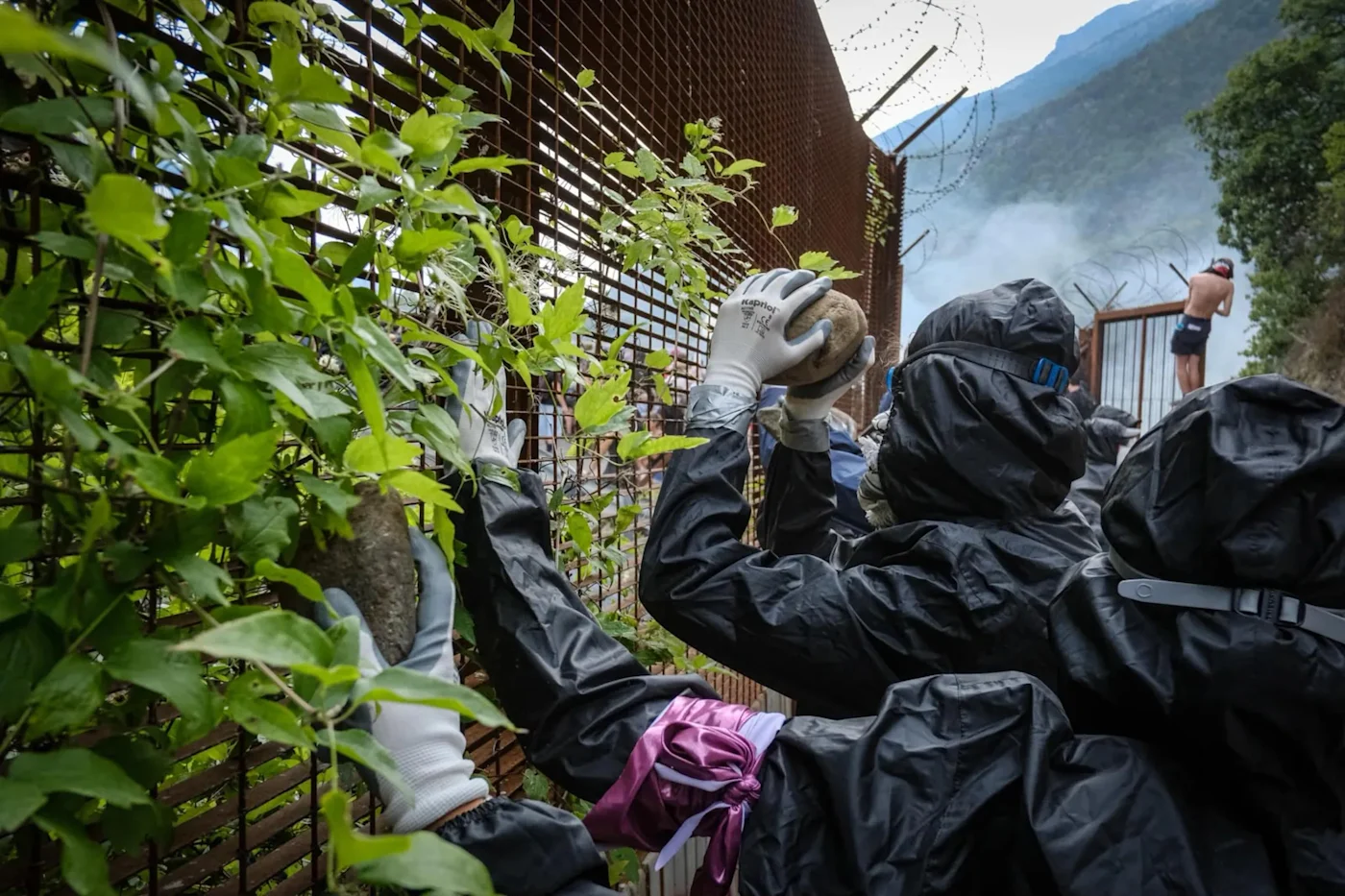
This is why the lazy effort to typecast and pigeonhole events always comes to nothing, whether its aim is to legitimize or criminalize. Such operations attempt to neutralize the political power of the rupture by reducing it to a symptom of something else, be it eco-anxiety or international conspiracies. It is for this reason that it must be combated.
In recent days, a media-driven controversy has erupted over the state of the No-TAV movement. Is the movement dead? Is it exclusively the domain of radical activists, most of them foreigners? The events of the 25th have reignited a thirty-year-old debate that had long been dormant. On one side are the major newspapers declaring the struggle to be dead; on the other are those who recognize that the events of the 25th have brought the TAV issue back into the spotlight.
And indeed, at the heart of what happened lies the TAV and the Susa Valley. Not the technical arguments about the project’s impact, the issues of environmental and health damage, or the administrative and infrastructural justifications. All this remains entirely true, but secondary. Every capitalist enterprise is an act of mafia-style land-grabbing — this case is as emblematic as countless others. But listing the injustices suffered, the rights trampled, or the many abuses of power will not move us forward one step. Everything is glaringly obvious to those who care to see it. The longstanding contempt for an entire region and the communities that inhabit it, along with the violent imposition of a state of emergency on the backs of those who have always rejected the high-speed rail line, only ensure that, once again, dialogue and words are entirely superfluous; they have lost all relevance and value.
The call of the Susa Valley, however, takes on a different meaning: a symbolic and ethical testament to a continuity of acts and gestures of resistance that, despite everything, still touch those who visit those territories today.
For along those same trails followed last month, the occupying forces have already retreated — on July 3, 2011 — the power lines have already been attacked, day and night, amid the same tear gas, and the construction vehicles have already gone up in flames. And images from these past events overlap, in a harmonious constellation, with those of the clashes that took place at the Milan central station, or on the evening of January 31 in Turin, the unrest in Bologna following Fakhir’s death, the resistance against ICE in Minneapolis, and many other moments that have punctuated these years — years that, from all sides, they would have us believe are doomed, broken, and without hope.
In our current historical epoch, the circulation of such acts of rupture and revolt takes on the substance of a shared repertoire and collective imagination that cannot be subsumed under any single political or programmatic discourse. All political solutions are ridiculous, inadequate, and dishonest; all ideological discourses ring false and out of step with their times. But the power of actions and practices that, despite everything, propel the heart beyond its obstacles, and point toward the building of a possible collective force…that, yes, that still seems to hold appeal and meaning. And we saw it on July 25.
Even today, there are many corners where people conspire, building relationships untainted by this society’s “values” — that is, by the pursuit of power and efficacy at any cost, by cynicism and callousness as a way of life.
Those who are attached to what they feel is right — struggles, actions, friendships — try to keep their distance from the publicity of social activism, from visibility as a measure of success, from the lies of politics, and from the fetish of ideological purity. Or if they inevitably find themselves pulled into these spheres, it is only with growing unease. Even the array of militant identities that society provides as bait to capture unruly behavior, forms of secession, and everything within it that appears ungovernable, is rightly perceived as a trap or, at the very least, a disappointing fallback.
This is why the faces of those who took to the streets for Gaza have not, for the most part, been seen swelling the ranks of groups and collectives, but seem to appear intermittently, punctually, at moments like that of the 25th. Is there truly no political dimension to these behaviors? Do the endless and meek complaints about the looming threat of fascism and war really have anything to teach us?
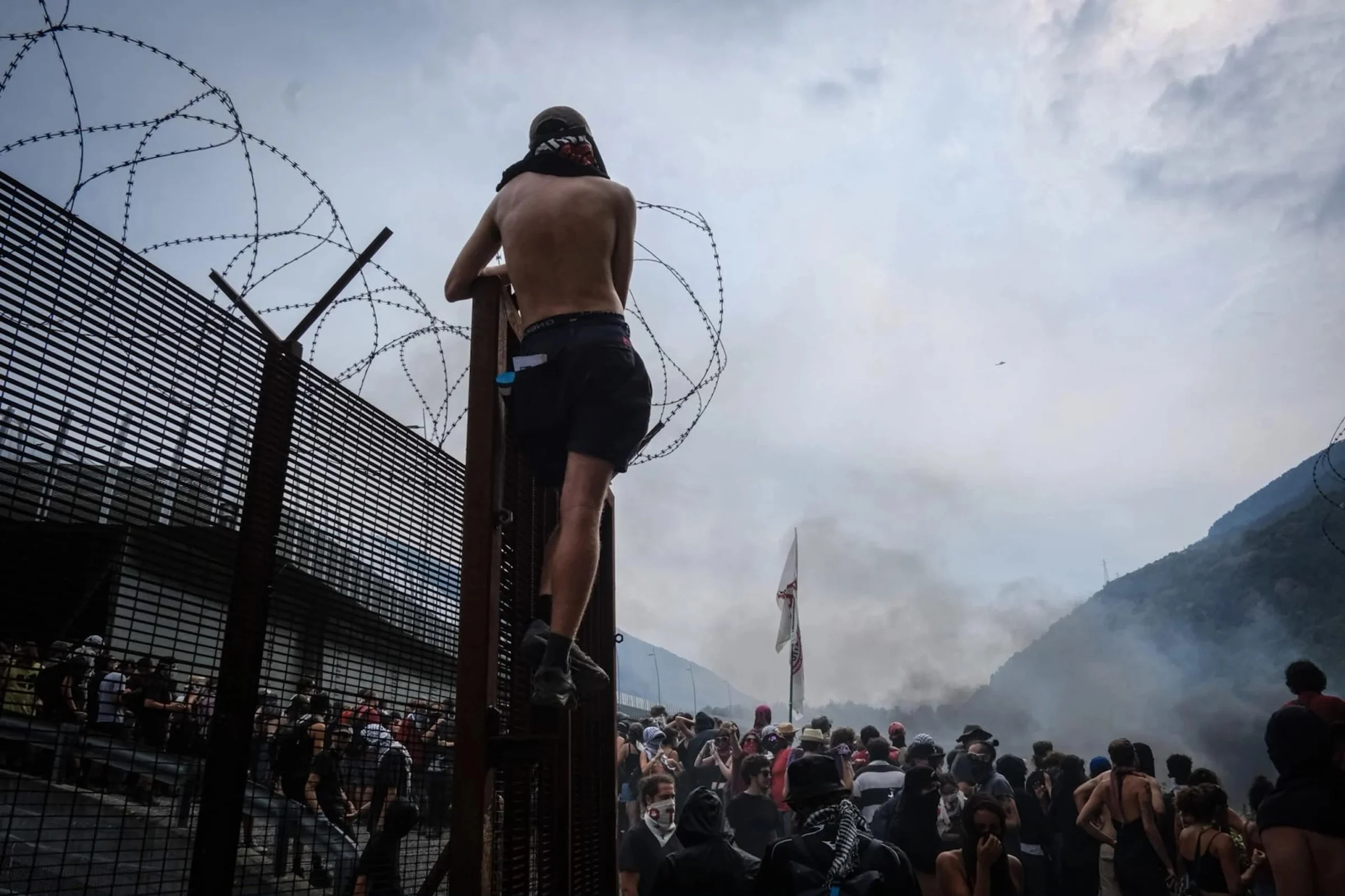
It is no coincidence that the government, through the tirades of its supreme leader, threatens those who provide food and shelter to the protesters in Valsusa. It is ridiculous, of course, but it reveals an awareness that the material fabric of relationships, friendships, and resources—which underpins a movement — its “conspiratorial” side, in fact — is more important than press releases and public calls.
Every true friendship, when it is taken seriously, when it is lived to the fullest, always has a conspiratorial character in relation to society. Its potential revolutionary power, its most intimate meaning, does not compromise with any public spectacle or self-denunciation, but rather lies in its essentially clandestine nature: in the discreet and patient deepening of relationships built on trust. All the more so when the public sphere, as everyone can see, is violently closing in on itself behind a shield of reactionary aggression. In such a context, exposing one’s bonds to the light of day can be a dangerous misstep. The reaction of the state apparatus to the events of the 25th offers striking confirmation of this, bringing the issue of opacity to the fore: how can one organize a force that remains accessible without being visible to the enemy?
If the choice is between taking refuge in individualism or paying a very high price for a tired affirmation of principles, perhaps it is worth glancing back over the past. The history of subversive movements is a history of plots woven in the shadows.
The epoch in which we live is not finished, because no epoch or historical moment ever really is. There are strategically unfavorable scenarios, but a collective force is not built by reasoning in the language of economic accounting — with its ironclad laws, its phases of expansion or recession, in the face of which one can do nothing but wait patiently. On the contrary, we are active protagonists [parti in causa]. Political actions and gestures — in the strongest and most authentic sense of the word — are not merely atmospheric phenomena to be recorded. Whether it be a statement, a text, or an attack.
Even those who sincerely fear the repercussions of repression, those frightened by a horizon that — it must be admitted — does indeed look bleak, should view the events of July 25 as a question: What’s the proposal for gaining some breathing room, for transforming reality? Where do the strengths and possibilities of the present lie? Is meekly accepting the rules of the game really the best response to a counterrevolution that attacks without reservation?
The epoch in which we live is not over, but it is dangerous. This can be clearly seen in Italy: we live in a historical moment in which a jewelry store owner who kills two desperate fugitives in cold blood — from behind, without a tremor in his hand — elicits more sympathy than someone who sabotages a construction site to oppose the devastation of a territory and a community. Of course, faced with such a situation, it’s understandable that a defensive stance might seem convincing. In short, keeping to the background, and looking for a way to disappear completely.
Yet even disappearance is an art, and conspiring means knowing precisely how to build while retreating: choosing when to speak, choosing when to act, at the risk of making mistakes. So, faced with this disorientation that affects us all — because no one with even a shred of honesty can claim to have solutions up their sleeve — and faced with events like those of July 25, of January 31, or the clashes in Bologna, and all the other upheavals that will inevitably occur, how should we behave? Should we defend the social normality that has led precisely to the current situation — to this fantastic “democratic stability” whose benefits everyone can see? Should we remain alone and frightened, locked in our homes and under guard, or should we take the question seriously?
And you, what do you think?
Translated by Ill Will