Proto-Politics in Purgatory
Crixus Babeuf and Ulysses Batko
The following text, submitted anonymously via email, was written by two communists based in the suburbs of the Twin Cities to be physically distributed among participants in the anti-ICE struggle as an addendum to Phil Neel's essay, “Lies You Will Be Told,” some ten days later.
Other languages: Português
As we write this, some ten days have elapsed since the January 24 murder of Alex Pretti at the hands of veteran CBP agents Jesus Ochoa and Raymundo Gutierrez, abetted by four other still-unidentified federal law enforcement personnel. There are decades when nothing happens, weeks when decades happen — and then there are dekads when the world refuses to shake and when what should have happened struggles to emerge. The real movement sputters and stammers, while brief conflagrations of proletarian vengeance resist coalescing into the necessary rupture. The cops are pushed out of Whittier, only for the barricades to be demolished by those same cops the very next morning, just as they were after Renee Good was murdered. Home2 Suites by Hilton in Minneapolis is desecrated and the ICE agents lodging there evacuated, while two days later hundreds of demonstrators at SpringHill Suites in Maple Grove hesitate to cross a sanctified line of police tape, the only barrier between them and the hotel property where, in a room with a number known to someone inside, Bovino rests his ill-shapen head.1 Though the nightly hotel demos have persisted, expanding their reach into even the most outer-ring suburbs, demonstrators have thus far failed to replicate the success at Home2Suites, while responding municipal police forces grow increasingly vindictive, saddling arrestees with ever more draconian charges for the crime of making a racket from the sidewalk. All gestures at escalation seem to subside back into the surreal new everyday life of patrolling neighborhoods, scouting for license plates, and responding — usually too late — to abductions which a crowd armed with whistles and cellphones is woefully ill-equipped to prevent, and somehow still occasionally manages to do so. “Rapid response” is the moniker that has stuck, but “ICE fishing” (to extend the term for the most monotonous of Minnesotan pastimes) feels more appropriate, given its actual pace and the highly stochastic nature of its infrequent successes. The new everyday life would be as tedious as the old one, if not for the fact that you very well might be shot for living it.
Thus far, few of the lies enumerated by Phil Neel have needed to be told. Rather than assuring us that the killers will be prosecuted, an ominous silence emanates from the halls of municipal and state power; perhaps they know we wouldn't believe them this time? And while we anxiously await the deluge out of whose wreckage a new “Umbrella Man” might be fabricated, the trickles of insurrectionary rain have been too meager for the left-wing of counter-insurgency to even bother invoking the spectre of the agent provocateur or “outside agitator.”2 The police and National Guard have shored up ICE's operational capacity, and yet there have been no riots, no strikes, nor even, in lieu of such a collective reckonings, any desperate shooting-back on the part of individuals.
The prevailing lie during this period of delirium is that we are winning, and that what we are doing is working. Like all lies, this one too bears its moment of truth. In the aftermath of Pretti's murder, thousands have admirably redoubled their efforts in patrolling and mutual aid, while thousands more have been freshly drawn in. The commitment and dedication of so many seemingly indefatigable Minnesotans has without a doubt saved lives and mitigated the horrors which the federal Gestapo would have otherwise wrought upon our neighbors. Immigration agents on the ground are, by all accounts, demoralized and burnt-out3, public opinion has turned decisively against ICE4, and some 700 feds are allegedly on the way out as part of Border Czar Tom Homan's so-called “Drawdown.” And yet, what the public thinks quite often has little to do with what actually happens5, the so-called Drawdown is an unsubstantiated assertion from an agency with no credibility whatsoever, and however many agents do remain — whether it's 3,000 or 2,300 — they are demoralized, yes, but neither gone nor incapacitated.
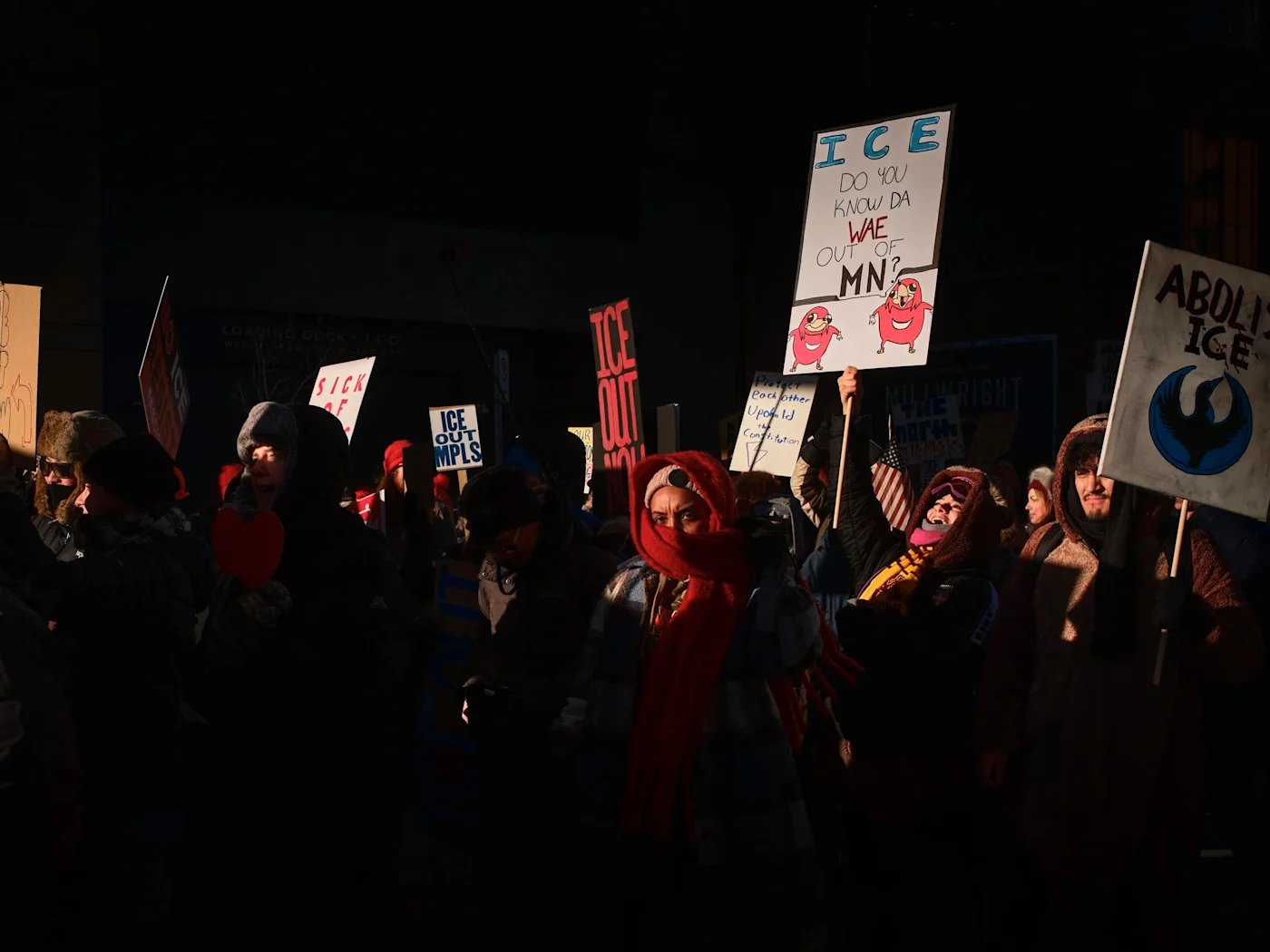
In a recent article, Ken Klippenstein assures us that “In ICE's War, the Public Is Winning.” It’s an unwittingly ironic title for an article detailing the stockpile of crowd control munitions federal authorities have amassed for dealing with that same public.6 Suppose we could believe Homan's “seven hundred” figure — that would still leave 2,300 ICE and CBP agents on the ground, more than three-quarters of the original Surge deployment (not, as Klippenstein somehow reckons, two-thirds). This is an order of magnitude greater than the number of immigration agents stationed here before the Surge, and more personnel than the five largest state, county, and municipal law enforcement agencies in Minnesota combined.7 Since Renee Good's murder, about the same number of people have been abducted and flown to concentration camps hidden in the deserts, swamps, and wastelands to await deportation, rendition, or worse.8 The rhetoric of the “Drawdown” notwithstanding, Trump has emphasized that abductions and deportations will continue unabated, and a Minnesota federal judge has recently reaffirmed the legitimacy of the Operation.9
We are not winning. The lie that we are serves as an understandable, yet nevertheless compensatory fantasy, forged under truly heartless conditions of daily abductions and abuses, alongside the unremunerated drudgery of a resistance which we desperately hope will pay off. This copium of the masses, in which we all can't but indulge to varying degrees, offers a brief respite from facing the unbearable reality that resistance as we've been conducting it has not only failed to push ICE out, but even to keep them from killing our patrollers, while exposing many of us to the same risk. “All our efforts are failures until we win,” as a deceased comrade once put it, and we haven't won until all ICE and CBP agents are out of Minnesota. Let us not be fooled by comforting but premature proclamations of victory. Concessions are never just concessions, but attempts at pacification and demobilization. The ouster of Gregory Bovino and replacement by Border Czar Tom Homan is just such an attempt.
In The Prince, Machiavelli tells of Duke of Romagna Cesare Borgia's recruitment of the "cruel and unscrupulous" Remmiro de Orco to oversee and subdue the inhabitants of a conquered territory.10 After terrorizing the population into submission on Borgia's orders, the Duke proceeded to dispose of his hatchet-man minister. Splaying de Orco's bisected body on the piazza for all to see, the Duke's bloody spectacle elevated him, in the minds of the very population he had subjugated, into the status of a liberator.
Bovino's mutilated corpse didn't need to be displayed on 26th and Nicollet; it was enough to send him into retirement for city and state leaders to be as "satisfied and stupefied" as the hoodwinked inhabitants of Romagna. In this way, the architect of family separation under Trump and Biden farcically becomes the poster child of the so-called “Drawdown,” while statistics meticulously compiled on the ground show no lull in ICE's activity since the departure of the erstwhile “Commander-at-Large.” Even before Homan's announcing a figure, Mayor Frey assured us that “some” federal agents had already left, as if that were enough, and as if he had any idea (surely he'd have provided a number if he had had reliable information). Governor Walz immediately reneged on any pretense of a sanctuary for migrants and announced his willingness to “work with” the new minister overseeing the abduction and murder of members of his constituency. Bovino disappears only for the hatchet-men to multiply. It would take a lot of severed corpses in public squares to leave us satisfied.
Only two weeks ago, as Bovino and his goons were daily terrorizing the residents of South Minneapolis, any talk of escalation met with the familiar scolding and admonishments to “not take the bait,” lest the Insurrection Act be invoked in a city already under de facto martial law, or an Alaskan Airborne Division be deployed to streets already patrolled by 3,000 trigger-happy federal agents and the bumbling National Guard. Now, with Bovino gone, those same shrill voices tell us not to escalate, because reasonable adults are back in charge, and that we made it happen. As we see it, it hardly matters that DHS has given no official reason for Bovino's dismissal, or that the “Drawdown” comes with no definite timeline or substantiated figures. Liberals have been tasked with spinning the narrative of a partial victory largely of their own accord, stumbling in their pacifistic stupor into holes drilled upon the frozen lake, captivated by the shiny colors of a plastic minnow. Talk about taking the bait! Hard or soft, when the counter-insurgency looms, the strategic prescription of these cowards remains the same: keep your head down and keep fighting the good fight, exactly as we have been, where what that consists of was precisely the outcome of previous escalations once reprimanded on those same grounds. The spirals of pacification and recuperation form a double-helix.


Are we content with the new business-as-usual? How sustainable is the newfound drudgery of our purely defensive modes of resistance? Will the endless and ever-defeasible legal battles be enough? Maybe in five years they'll result in some middling-brass getting a slap on the wrist for allowing license plates to be swapped out on his watch. Even the more participatory and empowering forms of resistance, rapid response above all, have had to continuously adapt amidst the changing tactics of the enemy, and have begun to show their limits under the current legalistic model, where responders are conceived of as mere “legal observers,” the green hat of the NLG being now swapped out for the whistle of the organic activist. The peddlers of legality would have us believe that there is nothing more to be done. Whether Bovino's departure and Homan's “Drawdown” will amount to a genuine concession won by “the movement” is, at this juncture, indeterminate. Partial victory or pacifying trick, the outcome depends on the resolve of Minnesotans to continue escalating and experimenting, honing their tactics, expanding their targets, and adapting to changed conditions while ceding no ground to the enemy. Continuing as we have been is grossly inadequate: to ourselves, to our neighbors, and to the memory of Renee Good and Alex Pretti. Regardless of anything we do or say, people (including us) will continue to engage in the legally and officially sanctioned forms of resistance which have sprung up since late November, and by no means do we mean to suggest that none of them will bear fruit — the fog of our delirious moment is far too opaque for such confident proclamations — but surely many of those same people yearn for something more than the eternal recurrence of the past two months.
For such individuals, there is another lie worth flagging, told so frequently that it hardly registers as a lie at all: that the significance of the rapid response networks which have organically arisen among large numbers of people across Minnesota lies, and solely ought to lie, in their serving as vehicles for “legal observation.” Official trainings and guidebooks emphasize — for good reason, we recognize — that responders are not “protesters” but legal observers. But that has never truly been the case. In the minds of most ordinary people, including rank-and-file responders, the value of rapid response resides more in its occasional successes in preventing abductions than in the evidence it passively marshals for legal cases. Who, after all, would risk being shot merely to passively spectate as their neighbors are abducted, all so that they might have some fodder for the attorneys later? When rapid response has succeeded at what has made it a mass mobilizing force, namely preventing abductions, it has invariably involved the sort of heckling and excessive noisemaking (officially proscribed in official rapid response trainings) through which legal observation bleeds into active obstruction, sapping the morale of federal agents in the field until they give up. Even the derided whistles are not, and never were, solely a tool for alerting our neighbors, but a low caliber auditory weapon for de-arresting would-be abductees. How could we more effectively prevent abductions and de-arrest our neighbors? It's time we expanded our arsenals.
In truth, it is the practice of rapid response that harbors the most potent seeds of strategic escalation. It is not hotel noise demos, not one-day sick-outs heralded as a “general strike,” not even autonomous direct action (all of which we support), and surely not LARPy, macho armed marches through the streets of South Minneapolis — but rather that most legally innocuous and inclusive mode of resistance which has so far exhibited the greatest potential in actually obstructing the deportation regime. (As an aside, it's worth noting that in the suburbs and rural areas, active patrollers and responders are disproportionately women, many of them mothers.) But the seeds gestating in the networks will only sprout when rapid response comes to recognize and realize itself as what it always has been, in all but its official codifications. The point doesn't escape our adversaries. In a viral tweet, former Green Beret Eric Schwalm plagiarizes ChatGPT to concoct a patently ridiculous but telling characterization of the “low-level insurgency infrastructure” of Minnesotans' rapid response networks.11 SchwalmGPT notes, not without accuracy, the intricate and sophisticated structure of the best and most developed of the rapid response networks, with their “disciplined comms,” differentiation and specialization of roles (dispatch, patrollers, observers, responders, intel, plate checkers), and savvy use of encrypted digital technology. Devised in response to ICE's adoption of more diffuse and lower-profile snatch-and-grab tactics, the rapid response networks have exhibited a highly elastic and adaptable structure which facilitates faster and more proactive tracking of the enemy's movements. Unsurprisingly, a man apparently incapable of writing his own tweets can hardly fathom that thousands of regular people have managed to develop these considerable collective capacities on their own, opting instead for the structurally antisemitic trope that these untrained commoners must have been “[f]unded [and] trained (somewhere).” We can't but find the more outlandish descriptions in SchwalmGPT's tweet flattering; but it is, alas, decidedly false that there has been much “[r]apid escalation from observation to physical obstruction — or worse.” Still, it gives us something to aspire toward.
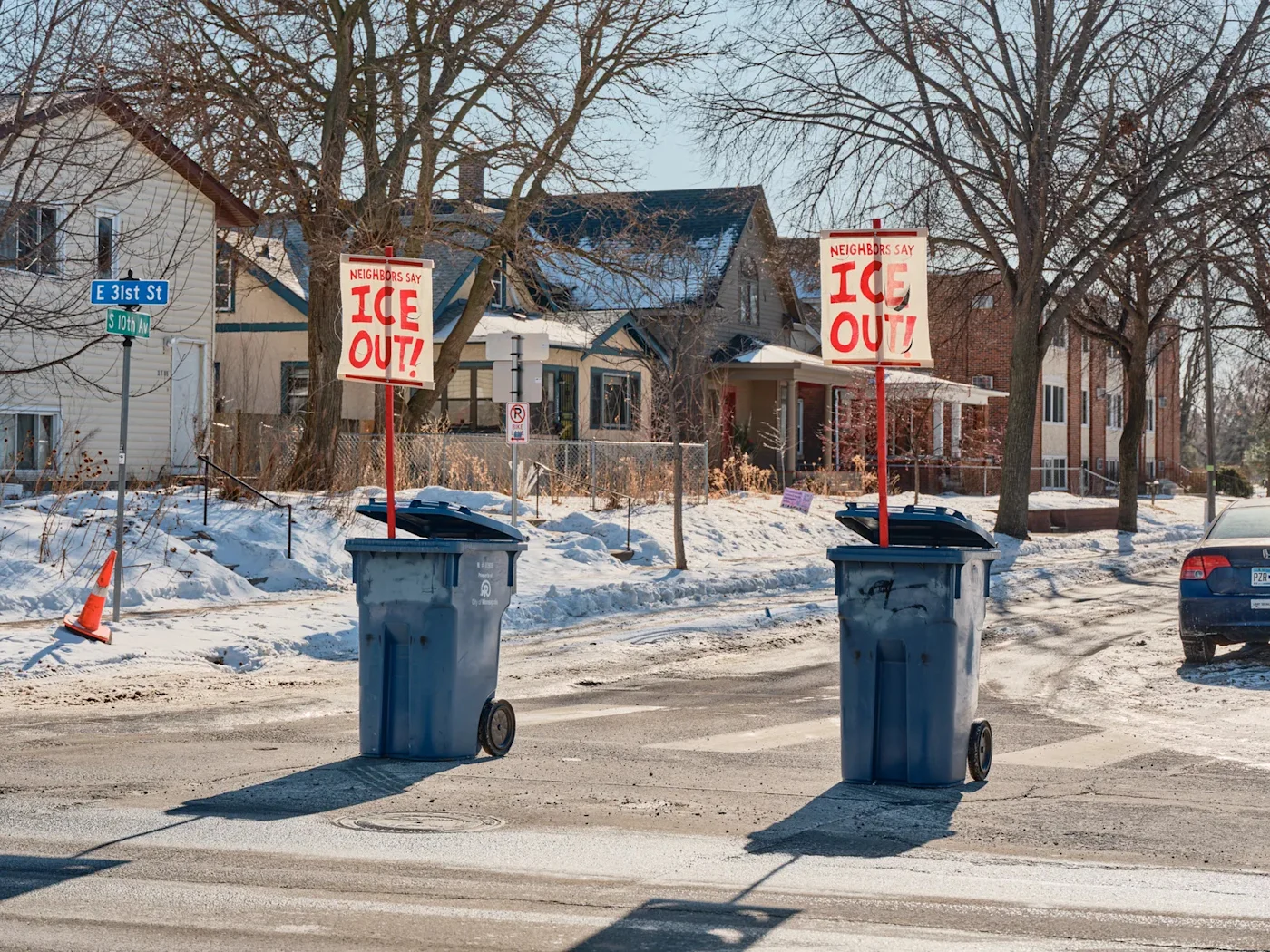
Far more pervasive than the “outside agitator” narrative has been the common refrain that responders escalating against ICE risks drawing “unnecessary attention” to vulnerable populations. If, for instance, off-duty federal agents at a restaurant were to be identified, heckled, and taunted as they ate, they might (the worry goes) target the restaurant staff more severely in retaliation. We have seen this logic at play in tensions between dispatch — which often prioritizes keeping a low-profile — and responders, who are not infrequently inclined toward bolder confrontations with federal agents. Dispatch standardly mobilizes responders only in the case of imminent abduction detailed in a corroborated SALUTE report, and otherwise discourages any interaction with federal agents lest the responders or the vulnerable be exposed to unnecessary risk of violence. But if ICE is truly not welcome here, then it should not be surprising that they should be tracked, filmed, auditorily stimulated, and harassed at every possible opportunity, not merely while they are staging or in the act of conducting a raid. (This is not to say that red-channel rapid response chats shouldn't limit their dispatch of responders to only the above-mentioned substantiated cases of imminent abduction.) The emergence of filter brigades in South Minneapolis are a promising development in this kind of expanded deployment of the resources of rapid response to disrupting ICE operations.12 If hostilities reached the point where ICE gave up on sit-down restaurants entirely, resorting to quickly scarfing down gas station hot dogs in parking lots while apprehensively glancing over their shoulders, we would be more sympathetic to the narratives of partial victories. It is, of course, understandable that resource-strapped rapid response networks might reserve their mobilizations for the most critical defensive interventions; but we should be careful of making a virtue out of this necessity, especially as fresh recruits swell our ranks and expand our latent capacities. The best defense of restaurant staff is an effective offense in which ICE learns through bitter experience that sitting down anywhere invites the real possibility of a demoralizing disturbance. In this, rapid responders have something to learn from the hotel noisemakers.
In addition to their latent insurgent potential, the Twin Cities’ rapid response networks signal the possible resurgence of a proletarian civic life independent of the mainstream two-party system and the institutions of a decrepit civil society and left-wing milieu. In the suburbs especially, thousands of working-class people have glimpsed the prospect of a more meaningful experience of community, following decades of atomization and a decaying social fabric. The formation of these networks, from Minneapolis and Saint Paul to the suburbs, and even into parts of the exurbs and rural hinterland, has provided a rich supply of oxygen and nutrients to the formerly comatose brain of working-class civic life, spurring the formation of new socio-neural connections. These proto-political networks harbor the potential to mature into class institutions tasked with coordinating sustained oppositional political and economic action, while restoring a social fabric promised, but never delivered, by so many astroturfed campaigns that too often accomplish little more than channeling our longing for collective agency into transferable email lists.
We must not ignore the obstacles we face: How might we foster organic ties between atomized people drawn into rapid response networks and the currently targeted groups they aim to protect, given that the built environment has generally been hostile to fraternization among these diverse segments of the proletariat? (Public schools have served as one of the few bastions of such fraternization — hence why they have also been the centers of mutual aid throughout the present struggle.) While intensified repression has sometimes brought these groups together, the necessary safety protocols of rapid response also constrict the possibilities for intimate ties between frontliners and those most at risk. The hinterland of the Twin Cities forms a vast and highly atomized wasteland populated by would-be school shooters, lone wolves, planetary death cults, and a disaffected populace that often intuitively and correctly recognizes the futility of many “organizing” efforts and left-wing projects. Despite these contradictions — soluble, of course, only in the course of experimentation on the ground — the connections and intimations of community exhibited by the rapid response networks are indeed the very sort that any coherent and long-term political project would require, at a bare minimum, to sustain itself and to keep its participants sane. The Minneapolis suburbs, in particular, have never, in any extant generational memory, been more activated than they are now, and their inhabitants are finding considerable meaning in their resistance to the deportation regime — they must be, otherwise they wouldn't endure the drudgery, much less the risk of death.
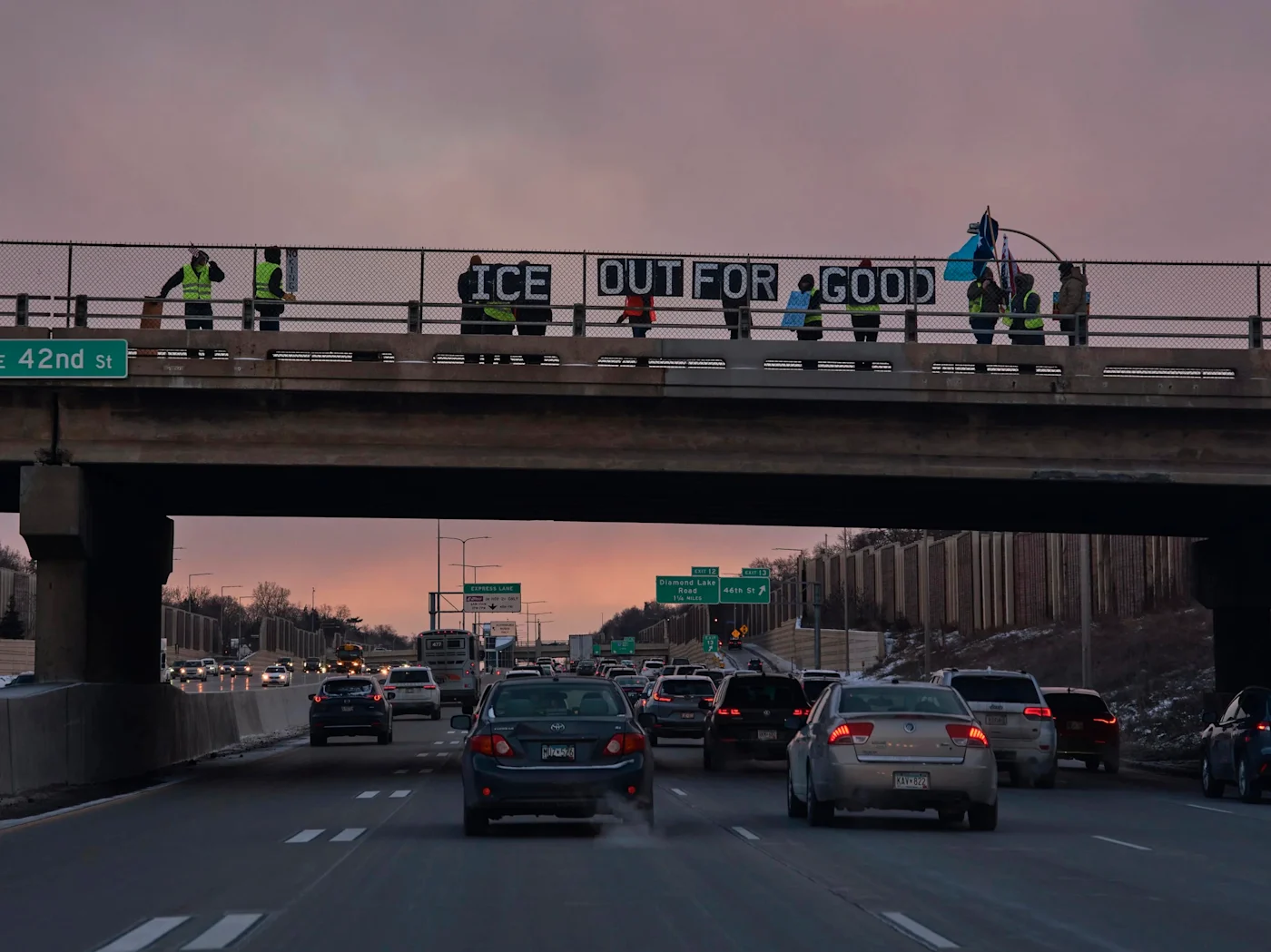
The lies we have been told serve to constrict the blood vessels of the burgeoning social brain of the rapid response networks, thereby debilitating an emerging collective intelligence. If these networks are to remain sustainable, it is imperative to keep expanding their infrastructure and fostering in-person coordination. The breakneck, schizophrenic pace of Trump's Blitzkrieg, coupled with the Signal fatigue of scrolling through innumerable chat groups of goofy-ass aliases, will surely burn many of us out, if not drive us insane. Striking a balance between security and community-building poses a real challenge, one evident in the rise of destructive paranoia and fed-jacketing amidst very real infiltration and surveillance. We must strengthen ties between rapid response groups and the many workplaces that pepper the suburban and rural landscapes, particularly among workers that tend toward depoliticization, and are even hallowed as such by the companies they work for. Perhaps that elusive resurgence of organized labor — ever proclaimed in the pages of Jacobin, all statistics be damned — is predicated on a prior need for basic community ties to be repaired. Perhaps with enough oxygen and coordination among networks and workplaces, there could arise a coalition of organizations constituting a sprawling nervous system throughout Minnesota, capable of effectively preventing abductions and mounting assaults on the architecture and logistics systems of the deportation regime.
The riots, strikes, and blockades predicted in the wake of Alex Pretti's murder have so far failed to materialize. However, so long as masses of people shrink back from flexing the collective capacities they've developed in an intensified assault on our enemy, the likelihood grows that a lone vigilante substitutes individual violence for collective insurgency. The shrill voices of restraint and legalistic “pragmatism” in this moment are the useful idiots for the predictably unpredictable bloodshed such an act would initiate. Strategically coordinated escalation and expansion of our attacks on the state and its complicit institutions — above all in the honing of rapid responders' abilities to actively prevent abductions — constitutes the alternative horn of the dilemma we face in our delirium. As always, there are no adults in the room and nobody is coming to save us: not Walz, not Frey, not the National Guard, not even a Luigi Mangione, and surely not the municipal and county police forces who are more concerned with upholding the inviolability of hotel property than that of human lives. It is we, and we alone, who might keep us safe. How many more of our corpses will have to appear on the streets before that happens?
First circulated in pamphlet format February 4, 2026; small additions added later in preparation for publication online.
Images: Philip Cheung
Notes
1. Anonymous, “The Noise Demonstrations Keeping ICE Agents Awake at Their Hotels,” Crimethinc, January 27, 2026. Online here.↰
2. Logan Anderson, “Who was Umbrella Man?,” The Star Tribune, May 30, 2026. Online here. ↰
3. Rhian Luban, “Morale is plummeting among ICE agents over long hours, quotas and public hatred: report,” The Independent, January 26, 2026. Online here. See also Nicholas Nehamas et al., “A Crisis of Confidence for ICE and Border Patrol as Clashes Escalate,” New York Times, Jan. 26, 2026. Online here. ↰
4. Matt Loffman, “Poll: Nearly two-thirds of Americans say ICE has gone too far in immigration crackdown,” PBS, February 5, 2026. Online here.↰
5. Martin Gilens and Benjamin I. Page, “Testing Theories of American Politics,” in Perspectives on Politics, Cambridge, 2014). Online here.↰
6. Ken Klippenstein, “In ICE's War, the Public Is Winning,” Substack, February 4, 2026. Online here. ↰
7. Authors' calculation. The relevant agencies are the Minnesota State Patrol, Hennepin County Sheriff's Office (HCSO), Minneapolis Police Department (MPD), St. Paul Police Department (SPPD), and Ramsey County Sheriff's Office (RCSO).↰
8. Kat Lonsdorf, “Minneapolis now has daily deportation flights,” NPR, February 6, 2026. Online here. The figure is based on flight-tracking data meticulously compiled and interpreted by activists, not the inflated DHS figures, which, like anything coming out of the current regime, is highly dubious.↰
9. Associated Press, “'Judge says she won't halt,” NPR, January 31, 2026. Online here. ↰
10. Machiavelli, The Prince, 27. Online here. ↰
11. Eric Schwalm, posted on X.com, January 25, 2026. Online here.↰
12. Anonymous, “Filter Blockades, A Tactic from the Twin Cities to Fight ICE and Defend Your Neighborhood,” Crimethinc, February 6, 2026. Online here. ↰